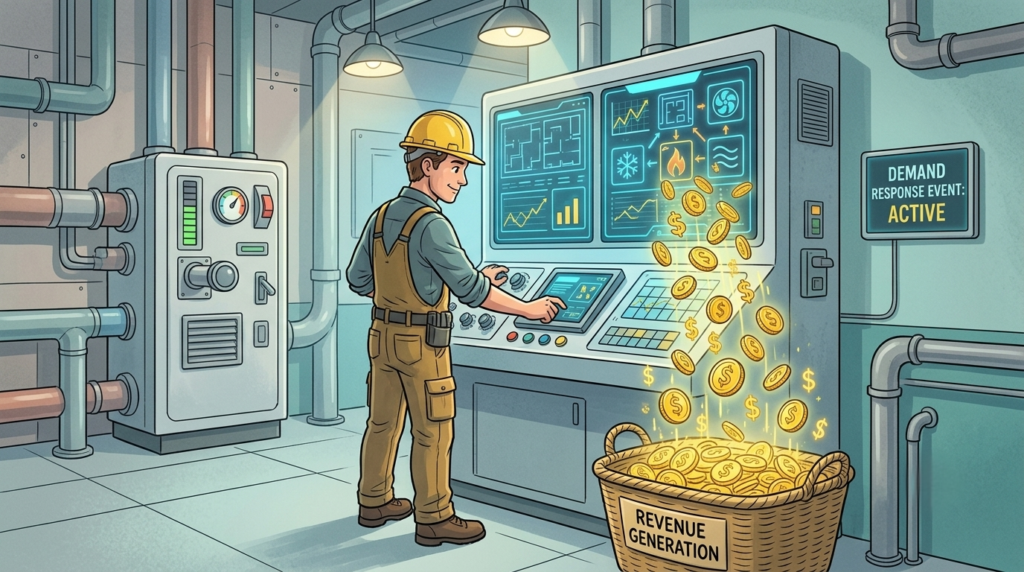

Running HVAC across one building is hard enough.
The traditional playbook for multi-site facilities is a patchwork: manual adjustments at each property, a different contractor in every market, and HVAC maintenance that happens only after something breaks.
That patchwork carries real costs.
Energy consumption and operational costs creep upward as inefficiencies go unnoticed across dozens of systems.
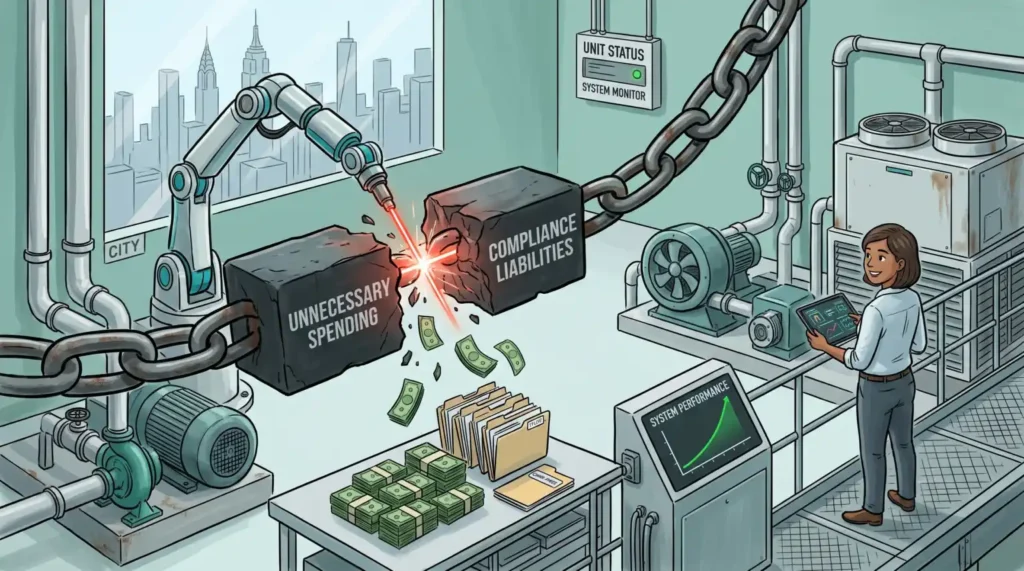
And compliance risk multiplies: a Local Law 97 (LL97) deadline isn’t one problem, it’s one problem per building, each with its own exposure.
The deeper issue is visibility.
When your data lives in separate systems at separate addresses, you can’t compare, prioritize, or act at the portfolio level.
The modern approach flips this: centralizing HVAC operations onto a single software platform allows every system, every site in a portfolio to come into one view.
That shift, from scattered and reactive to unified and proactive, is where the savings start.
Bringing your portfolio onto one platform pays off across four fronts.
Financial. This is the headline win. A unified platform surfaces waste you couldn’t see site-by-site and drives reduced energy costs across every building at once.
Optimize centrally and the energy savings compound.
In multifamily buildings and hotels, that typically means pulling 20–30% out of energy consumption.
Operational. One platform means standardized HVAC maintenance instead of one process per contractor.
You can move from reactive fixes to preventive maintenance driven by real system data, dispatch technicians where they’re actually needed instead of on a blanket schedule, and most importantly, gain portfolio-wide visibility.
Instead of chasing status across a dozen buildings by phone, you see them all on one screen and act on the ones that need you.
Occupant experience. Consistency is hard to deliver across sites by hand; software makes it the default.
Fewer complaints mean happier residents and guests, and fewer late-night service calls for your team.
Compliance. A single platform turns a scattered regulatory headache into a managed one.
Track every building’s performance against standards like LL97, BERDO, or BEPS from one place, see which properties are at risk, and act before penalties land rather than after.
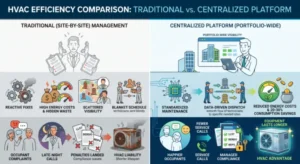
HVAC Efficiency Comparison: Traditional vs Centralized Platform
Furthermore, there’s a quieter benefit underneath all of these: system lifespan.
Equipment that runs efficiently and gets attention before it fails simply lasts longer.
Put together, a unified platform doesn’t just make managing HVAC systems across multiple sites easier. It turns HVAC from a portfolio-wide expense into a portfolio-wide advantage.
Not all platforms are equal.
Use this checklist when you evaluate multi-site HVAC management software for a portfolio:
A centralized dashboard. Everything on one screen — every site, every system, every alert.
This is the “single pane of glass” that replaces the spreadsheet-and-phone-call routine.
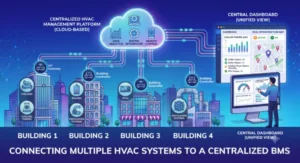
Real-time monitoring and alerts. Real-time visibility means you learn about a problem as it develops, not when a resident calls. Good alerting is specific and prioritized, so your team knows what needs attention first.
Predictive maintenance powered by AI/ML. Machine learning watches equipment performance and flags anomalies before they become failures, turning HVAC maintenance from reactive to predictive and protecting asset health across the portfolio.
Asset performance tracking. You should be able to see how each system is performing over time, benchmark buildings against each other, and spot the underperformers that are quietly costing you.
Robust reporting and advanced analytics. The platform should allow you to turn raw data into real results like savings achieved, compliance status, where to invest next, in reports you can actually put in front of an owner without a week of spreadsheet work.
Here’s the distinction that matters most, and where many tools quietly stop short: monitoring is not optimization.
A platform that shows you a beautiful dashboard of problems still leaves the work, the adjustments, the tuning, the follow-through, on your team’s plate.
The real differentiator is a solution that actively controls and optimizes them.
Hold every solution you evaluate to that higher bar, and ask each vendor plainly: does your platform tell me what to do, or does it do it?
The most common objection to a new platform is a fair one: “I don’t want to rip out what I already have.”
You don’t have to.
A modern multi-site HVAC management system is built to integrate with your existing infrastructure, not replace it.
A good building management solution connects to the Building Management System (BMS) and equipment already in your buildings, and adds a layer of intelligent automation on top.
Your systems keep running. They just start running smarter.
Many buildings run on building automation frameworks like Niagara 4 and communication protocols like BACnet, which are designed precisely so systems from different manufacturers can talk to each other.
A capable platform speaks these languages, which is what lets it pull data from, and send optimized instructions back to the equipment you already own.
The practical takeaway for a portfolio manager: integration is an enhancement project, not a construction project. There’s no rip-and-replace.
For occupants, the process is invisible. For your team, it’s a connection and a configuration handled building by building, not months of disruption or a mechanical room torn apart.
The lower the barrier to integration, the faster the savings start, and the easier the decision is to defend to an owner who’s understandably wary of another big infrastructure project.
When you shop for a solution, you’ll really be choosing between two philosophies.
Understanding the difference is the difference between data and dollars.
Monitoring and analytics platforms give you information. They collect data from your systems, show it on a dashboard, and flag issues.
That’s genuinely useful, but the action is still yours.
The platform tells you something is wrong; your team still has to decide what to do and go do it, across every site.
Automated optimization and control services close that loop. Instead of just reporting, they actively manage the systems: making the real-time control adjustments, tuning continuously, and taking responsibility for the result.
You don’t get a to-do list; you get an outcome.
Here’s the analogy that makes it click: the shift from manual to automatic driving.
Manual driving still requires you to do all the work.
Automatic driving features allow you to stay behind the wheel in cruise control, stepping in only when you have to.
An automated optimization service is the car on autopilot.
It doesn’t just measure; it does the work with you.
A dashboard’s insights are only as good as the hours your team has to act on them, and those hours are exactly what’s scarce across many buildings.
Across a dozen sites, even the best monitoring platform leaves most of its potential unrealized because no one has time to chase it.
This is the real fork in multi-site HVAC management: passive data versus active control.
Parity sits on the active side: a service that runs your HVAC, making real-time control adjustments across every site with guaranteed energy savings.
The outcome isn’t a hope, it’s a commitment. When you compare approaches, the question isn’t which dashboard looks best, it’s who’s accountable for the result.
Every portfolio decision comes down to the numbers, so here’s a simple framework for the Return on Investment (ROI) of optimizing multi-site HVAC.
Start with a straightforward shape:
Annual ROI ≈ (Total annual savings − annual cost of the service) ÷ your investment
The reason multi-site optimization tends to pencil out well is that “total annual savings” has four components, not one:
Add those four, subtract the cost of the service, and the case usually makes itself, especially under a model where there’s zero upfront investment options and the savings are guaranteed, which removes the “investment” risk from the equation entirely.
That’s the part worth bringing to an owner.
Most efficiency pitches ask them to spend now for a return later and carry the risk in between. A guaranteed, savings-funded model asks them to share in a return that’s contractually protected.
Curious what your portfolio could save? Get a free savings assessment and we’ll build the projection on your real numbers.
Once you’ve decided to modernize, choosing the right partner is the most important call.
Three criteria matter most for facilities managers evaluating a multi-site HVAC management company:
Pricing model. This is where risk lives.
Some vendors charge a Software-as-a-Service (SaaS) fee regardless of results.
Parity offers zero upfront investment options and guarantees the savings, which makes it about as close to a risk-free choice as portfolio decisions get.
When you compare pricing, ask the plain question: what happens if the savings don’t materialize?
A guarantee answers it.
Scalability. Your portfolio will change: properties added, markets entered.
The right platform handles that growth without a re-implementation each time. Ask whether onboarding a new building is a quick add or a project.
Vendor support. There’s a real difference between a software login and a partnership.
Some providers hand you a tool and a help desk; others put a team behind your systems.
Understand what you’re actually getting: Is there a team handling optimization and service dispatch, or is that back on you? Who do you call when something breaks at 11pm?
The answer tells you whether you’re buying software or buying an outcome.
The pattern across all three: look for a partner whose incentives line up with yours.
A guaranteed-savings model, built to scale, backed by a real team, means the provider only wins when your buildings do.
A vendor on a flat fee has no stake in whether the savings show up, while a partner paid from the savings chases them across every site.
For facilities managers evaluating options, one test cuts through the pitches: ask each vendor what they’re on the hook for.
A monitoring tool is on the hook for uptime. A true optimization partner is on the hook for results.
Multi-site HVAC management has changed.
What used to be a manual chore – chasing contractors, reacting to failures, guessing at compliance – is now a strategic advantage for the portfolios that modernize.
The path is clear.
Centralize your systems for portfolio-wide visibility. Move from reactive to proactive maintenance. And choose active optimization over passive monitoring, so the savings actually land instead of sitting unread in a dashboard.
Done right, you get cost savings, regulatory compliance, and better occupant comfort, without a capital overhaul or a leap of faith.
With the right partner, you don’t have to trade one goal for another.
Multi-site HVAC management has changed.
What used to be a manual chore – chasing contractors, reacting to failures, guessing at compliance – is now a strategic advantage for the portfolios that modernize.
The path is clear.
Centralize your systems for portfolio-wide visibility. Move from reactive to proactive maintenance. And choose active optimization over passive monitoring, so the savings actually land instead of sitting unread in a dashboard.
Done right, you get cost savings, regulatory compliance, and better occupant comfort, without a capital overhaul or a leap of faith.
With the right partner, you don’t have to trade one goal for another.
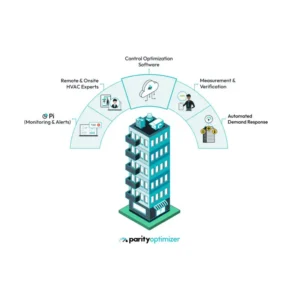
Parity’s Optimizer service optimizes the systems already in your buildings, guarantees the savings, and offers zero upfront investment options, turning your portfolio’s largest controllable cost into a lever you finally control.
Multi-site HVAC management stops being the thing that reacts to you and starts being the thing that works for you: one view, one standard, one team accountable for the result across every property you run.
Ready to take control of your portfolio’s energy spend? See how it works, or reach us at contact@paritygo.com · 1-833-372-7489.