
For a multifamily building or hotel, HVAC isn’t just another line item. It’s usually the largest one you can actually control.
Over 50% of a residential building’s energy use is driven by Heating, Ventilation, and Air Conditioning (HVAC) systems which means every point of inefficiency shows up directly on your utility bills, month after month.
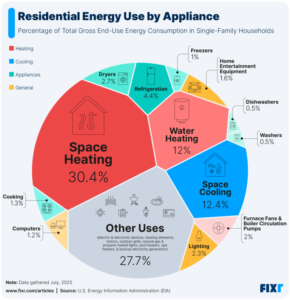
Image source: Fixr, A pie chart illustrating ‘Typical Energy Consumption in a Commercial Building’ with HVAC as the largest slice.
That makes HVAC energy consumption the highest-leverage place to cut operating costs. But cost is only half the story now.
HVAC energy efficiency has become a compliance issue, a tenant-satisfaction issue, and a sustainability issue all at once.
The regulatory pressure is real: building performance standards like Local Law 97 (LL97), BERDO, and BEPS, put a price on wasted energy, and the penalties tighten over time.
And residents simply expect consistent comfort; a building that wastes energy often still delivers hot-and-cold complaints.
The environmental stakes are just as direct. An inefficient building carries a heavier carbon footprint, a real environmental impact, and falls short of the sustainability goals homeowners and boards increasingly demand.
Here’s the part worth holding onto: these goals don’t compete.
An energy-efficient HVAC system lowers energy costs, shrinks carbon emissions, eases compliance exposure, and improves comfort. Four problems, one solution.
You can’t manage what you can’t measure, so start with the ratings.
A handful of metrics describe how efficiently equipment turns energy into heating or cooling.
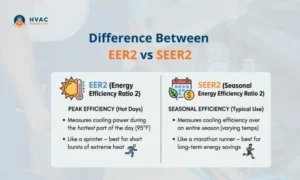
Image souce: HVAC Services Pro, A comparison table: ‘SEER vs. SEER2: What’s Different?’
In 2023, the U.S. Department of Energy (DOE) updated these to new standards: SEER2, EER2, and HSPF2. The important change wasn’t the equipment, it was the test.
The new procedures measure units under higher external static pressure, which better reflects the real-world resistance of actual ductwork rather than idealized lab conditions.
In plain terms: the “2” ratings are a more honest measure of how equipment performs once it’s installed in a real building, with real ducts and real airflow restrictions.
Because the test is tougher, a unit’s SEER2 number is somewhat lower than its old SEER number for the same hardware, so you can’t compare a SEER2 rating directly against a legacy SEER rating without converting.
Why this matters: these efficiency ratings are the language of both new-equipment specification and compliance.
When you replace a system, the 2023 standards define your minimum allowable efficiency. Understanding them keeps you from over-buying efficiency you won’t recoup or under-buying and failing code and, just as importantly, from mistaking a glossy lab number for real-world performance.
When a contractor quotes you a rating, you’ll know exactly what it means and what it doesn’t, and you’ll be able to compare two bids on equal footing instead of taking the higher number on faith.
In a large residential building, that clarity can be worth thousands over the life of the HVAC equipment.
Before any capital project, capture the low-cost wins. These deliver efficiency gains fast, often for the price of labor.
An HVAC tune-up is far more than a filter change. Coil cleaning restores heat-transfer efficiency that dirt quietly steals. Refrigerant-level checks keep cooling from working harder than it should. Electrical-connection inspections catch the small faults that become big failures. A proactive maintenance schedule keeps equipment running near its rated efficiency instead of drifting downward all season.
Even a perfectly efficient unit wastes energy if the air never reaches the space. Poor ductwork condition is a common, invisible drain. Conditioned air leaking into ceilings and shafts before it does any good. Duct sealing and proper insulation stop that loss, which improves efficiency and occupant comfort at the same time, since rooms actually get the air they’re supposed to.
Smart, programmable thermostats and modern controls optimize runtimes and temperature setpoints automatically, helping you save energy during unoccupied hours and adjusting to real conditions instead of running on a fixed, forgotten schedule. Even in larger buildings, better control logic squeezes out waste that manual settings leave on the table, night after night, with no one having to remember to adjust anything.
None of this requires new equipment.
It requires attention, the kind that’s easy to postpone across a busy portfolio, which is exactly why so much efficiency sits unclaimed in buildings that already have perfectly good systems.
The equipment isn’t the problem; the drift is.
Lock in the fundamentals first, and every upgrade you make later starts from a stronger baseline. You’ll also get a cleaner read on which systems genuinely need replacing versus which were just poorly maintained.
Sometimes maintenance isn’t enough and it’s time to invest.
The question is when and how to do it in a building that wasn’t designed for modern systems:
Upgrades and retrofits pay off most when they’re approached as a system, not a swap.
Right-size the equipment, insist on installation quality, and treat the building as a whole.
That’s how you reach peak performance instead of just newer equipment running against the same old losses, and how you avoid the common trap of buying an efficient unit that never delivers its rated numbers.
Efficiency isn’t only a choice anymore. Increasingly, it’s the law.
Knowing the landscape keeps you ahead of both minimums and penalties.
First, there are federal minimums.
The DOE mandates the floor: the minimum efficiency any new HVAC equipment must meet (the 2023 SEER2/EER2/HSPF2 standards are the current example).
These determine what you’re even allowed to install when you replace a system.
On top of federal floors, state and local building codes add their own requirements, and they vary by market.
Standards such as those from ASHRAE inform much of this local code, shaping how buildings must be designed and operated for efficiency.
Know the code in each market you operate in. Assuming one city’s rules apply in another is a costly mistake.
Properties can also opt for voluntary benchmarks. The ENERGY STAR® label is the trusted, recognizable mark of efficiency.
It’s not mandatory, but it’s a credible benchmark for equipment and buildings alike and a useful signal to owners, tenants, and lenders.
Finally, building performance standards. This is where efficiency meets your budget most directly.
Standards like NYC’s Local Law 97 set emissions caps on buildings and levy financial penalties for exceeding them. With HVAC as the biggest energy consumer, it is the biggest lever for staying under the cap.
In other words, HVAC efficiency isn’t just about lower bills; it’s about avoiding fines that grow steeper each compliance period.
For a portfolio, the practical move is to map each building’s exposure now.
Compliance is far cheaper to plan for than to pay for and, unlike a fine, efficiency spending earns a return.
For more on where these rules are heading, see our take on building performance standards.
Efficiency has to pencil out. Here’s how to build the business case, and find money to fund it.
Frame it as life-cycle cost, not sticker price. A cheap unit that burns more energy for a decade is the expensive choice.
A proper cost-benefit analysis weighs the cost of an efficient HVAC system and installation against projected energy savings over the system’s full lifespan.
That’s the number that matters: total cost of ownership, not the invoice.
Calculate the ROI on real data. The basic shape:
Simple payback (years) ≈ net upfront cost ÷ annual energy savings
To ground it, analyze your utility bills to benchmark current performance, then estimate savings from the specific upgrade.
Use your own consumption data, not a generic percentage, so the projection holds up to scrutiny.
Layer in long-term cost savings from reduced repairs and longer equipment life, and the case strengthens further.
Don’t leave incentive money on the table. Efficiency upgrades often qualify for support that dramatically shortens payback:
These change often and differ by location, so research current programs where each building sits before you budget, a rebate can turn a marginal project into an obvious one.
Curious about your potential savings? Contact us for a complimentary energy savings assessment.

Beyond standard HVAC equipment, a set of technologies pushes efficiency further. Knowing them helps you spec smarter, and see where the real gains now come from.
Traditional motors run flat-out or off. A VFD modulates a motor’s speed to match the actual load, running a fan or pump at 60% when that’s all the building needs instead of 100% all the time. Because energy use drops sharply as speed decreases, VFDs are one of the highest-impact ways to save energy on pumps and fans.
Bringing in fresh air is necessary for Indoor Air Quality (IAQ), but conditioning that outside air is expensive. An ERV captures energy from the air you’re already exhausting and uses it to pre-condition incoming fresh air, cutting the heating and cooling load without cutting ventilation. In a multifamily or hotel setting, that’s a meaningful, continuous way to save energy.
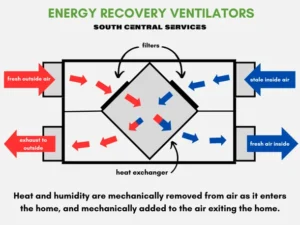
Image source: South Central Services
A BAS is the brain for commercial HVAC, the central nervous system that coordinates equipment, schedules, and setpoints from one place. It’s the foundation for centralized control and the platform advanced optimization builds on. Without a BAS, systems run in isolation; with one, they can be orchestrated together.
High-efficiency heat pumps move heat rather than generating it, delivering more heating and cooling energy per unit of electricity, and geothermal systems push that efficiency even higher by exchanging heat with the stable temperature underground. Both are central to long-term decarbonization strategies and increasingly favored by incentive programs and building performance standards alike.
Here’s the frontier, though: hardware sets the ceiling, but how intelligently it’s run determines what you actually capture.
A high-efficiency chiller controlled by static rules still leaves savings on the table every hour conditions change.
Even the best equipment and a capable BAS need continuous, expert optimization to hit their potential, the advanced HVAC technologies above are the instruments, but someone still has to play it well, all day, every day.
That’s exactly where automated, real-time control comes in, and it’s the gap between a building that could be efficient and one that consistently is.
Pull it together and the picture is clear: HVAC energy efficiency is a combination of proper maintenance, smart upgrades, and the right technology, each reinforcing the others.
But there’s a shift underneath all of it.
Managing HVAC is no longer a “set it and forget it” task.
A building’s needs change by the hour — weather, occupancy, energy prices — and static settings, however well chosen, can’t keep up.
The efficiency you locked in at installation quietly erodes the moment conditions move.
That’s why the real unlock is continuous, real-time optimization: proactive management that adjusts systems automatically, all day, every day, to match actual conditions.
It’s the difference between reactive fixes and operational efficiency that compounds, capturing savings that periodic maintenance and one-time upgrades leave behind.
Holding your building at peak performance instead of letting it drift back toward waste the moment the weather or occupancy shifts.
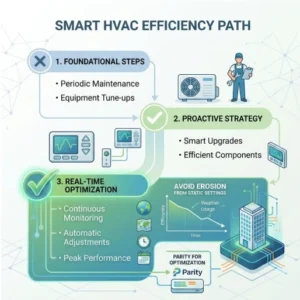
This is where Parity fits.
Our Optimizer service delivers exactly that layer of real-time control over the systems you already have, turning the strategies in this guide into a managed, ongoing outcome, with guaranteed savings and no upfront investment.
You don’t have to choose between maintenance, upgrades, and technology; HVAC optimization is the layer that makes all of them pay off to their full potential, and keeps paying off long after the last upgrade is installed.
It’s the shift from doing efficiency once to actively running it as a continuous discipline.
Want proof? See how we guaranteed savings for a real building – the 252 East 57th Street case study.
Reach us at contact@paritygo.com · 1-833-372-7489.