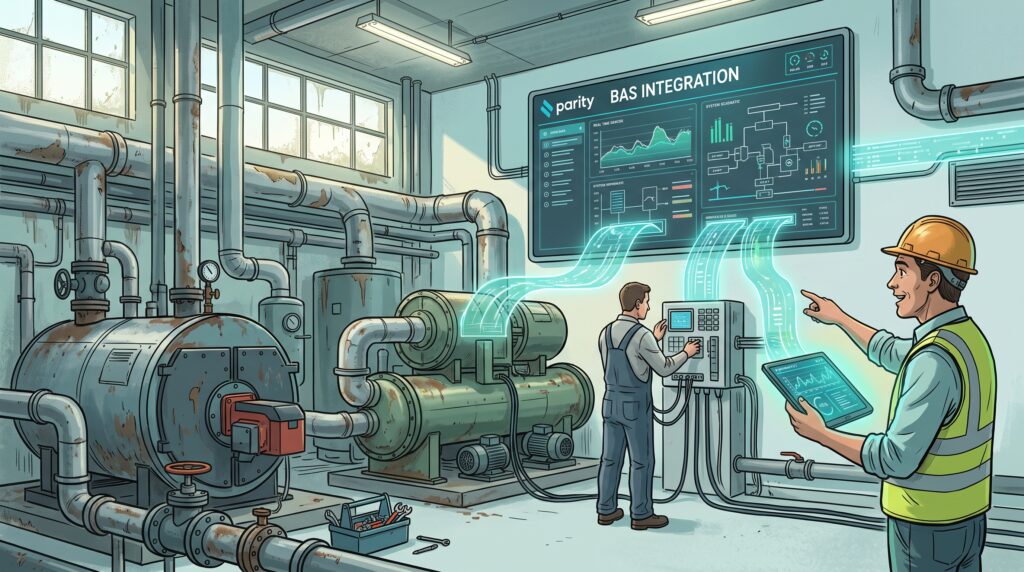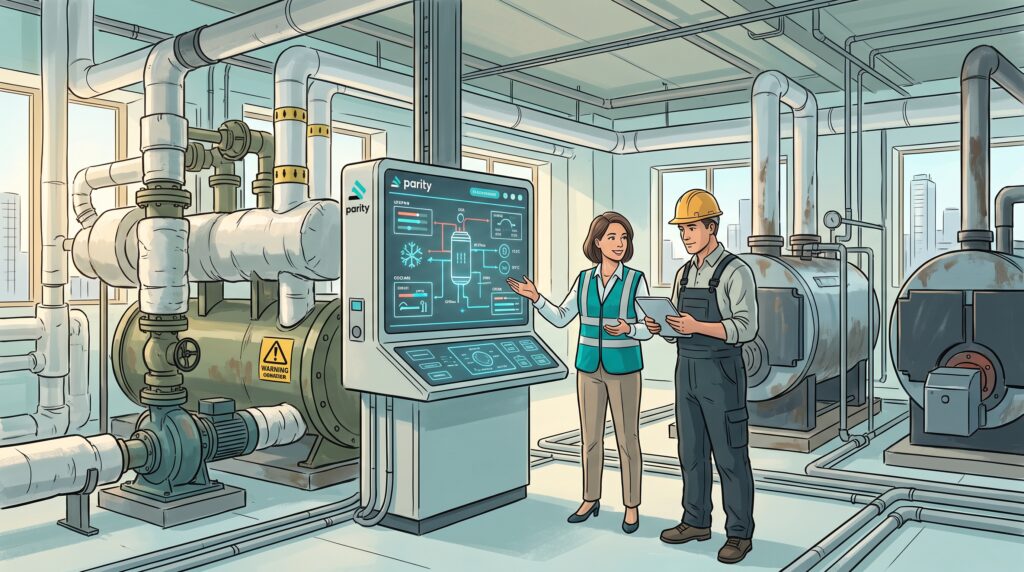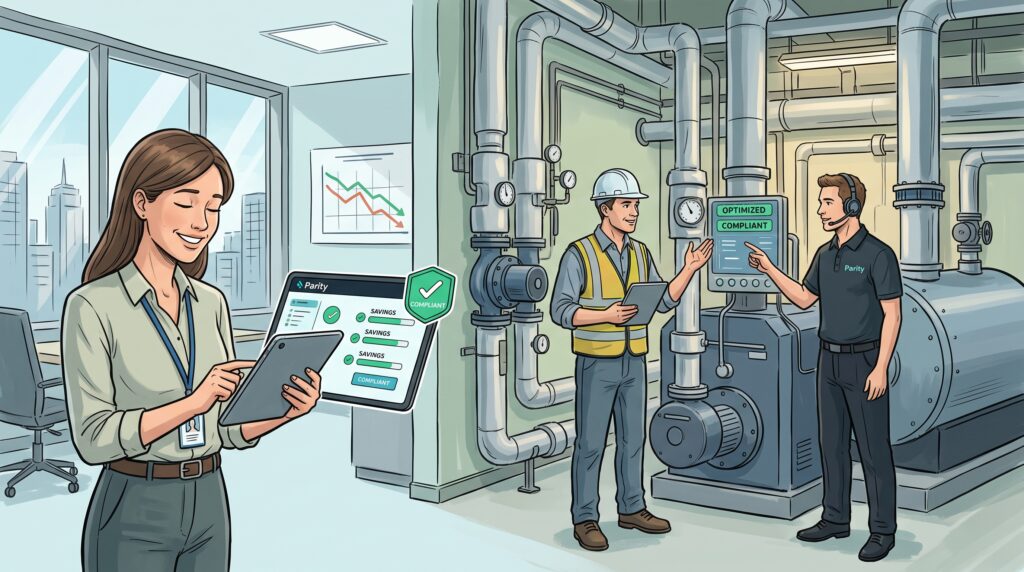
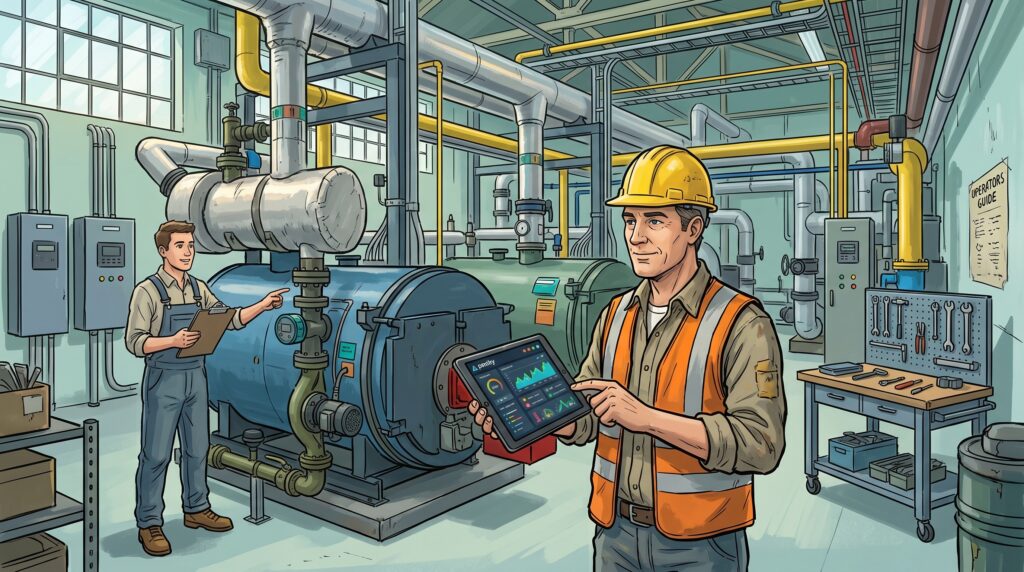
Look at your utility bill and ask where the money goes. In most multifamily buildings and hotels, the answer is the mechanical room.
HVAC systems are the largest energy user in most commercial buildings and multi-unit residential properties. The U.S. Department of Energy (DOE) identifies HVAC as the single largest energy end use in U.S. buildings, and industry estimates commonly put it at 40% or more of a commercial building’s total energy consumption. That makes it the biggest line in your operational costs, and your biggest lever for improving energy efficiency.
The problem usually isn’t the equipment. It’s how it runs.
Reactive adjustments. Most building operations still run on complaints. A resident calls, a setpoint changes, and the change sticks long after the cold snap ends.
Systems running when nobody needs them. Boilers fire on fixed schedules, ventilation runs at full speed in empty spaces, and pumps hold speed regardless of load.
No response to real-time conditions. A static schedule can’t see tomorrow’s forecast, today’s occupancy, or this afternoon’s price spike.
Each one is small. Together, they quietly inflate utility costs every day of the year. Closing that gap is what HVAC energy management is for.
Your biggest cost is also your most controllable one, as long as something is actually controlling it.
An HVAC energy management system (EMS) is a centralized, technology-driven platform that monitors, controls, and optimizes a building’s heating, ventilation, and air conditioning in real time.
You’ll also see the term Energy Management Control System (EMCS). The two are used almost interchangeably; EMCS simply puts the emphasis on control rather than reporting.
Every EMS has three core components:
How it works. Sensors read conditions, controllers decide, actuators act, and the sensors confirm the result. That loop runs continuously, minute by minute, day and night.
How it differs from manual control. A basic thermostat knows the temperature in one room. A Resident Manager adjusting a boiler setpoint knows what the weather felt like at 7am. Neither sees the whole building, and neither acts at 3am.
Why it matters in multi-unit buildings. In a multifamily building or hotel, HVAC control is spread across boilers, pumps, ventilation fans, and hundreds of terminal units. An EMS ties them together so they operate as one system instead of dozens of independent ones.
Building controls have existed for decades. What’s changed is how much data they collect, and how much they can do with it.
A thermostat reacts to a room. An EMS manages a building.
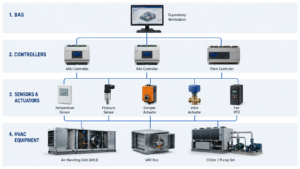
Image Source: Turn2Engineering
Technology is only worth it if it changes the numbers you report on. HVAC energy management changes three sets of them.
Here’s what most business cases miss: these benefits compound. The same control decision that trims a gas bill also cuts emissions and reduces wear on the boiler. That’s why the real return on investment usually outruns a single-line savings estimate.
You’re not buying a cost-cutting tool. You’re buying control over your largest operating expense.
Most buildings already have some form of scheduling. Modern HVAC management goes several steps further.
Remote monitoring. Real-time monitoring streams equipment data to a cloud platform, so your team can see every boiler, pump, and air handler from a laptop or phone. No more walking the mechanical room to find out what’s running.
Data analysis. The platform stores that energy monitoring data and analyzes it continuously. It builds a baseline for how your building behaves and flags when performance drifts away from it.
Predictive, intelligent control. This is where the savings live. Advanced algorithms combine building data with outside inputs (weather forecasts, occupancy patterns, and energy pricing) and adjust equipment ahead of conditions, not after them. A cold front is coming, so the system starts heating earlier at a gentler firing rate. A price spike is forecast, so it pre-cools before the expensive hours begin.
Automated fault detection. The same data powers remote diagnostics. When a pump draws more power than its baseline or a zone stops responding, the system flags it, often naming the likely cause, before anyone files a complaint.
This is what people mean by AI HVAC energy management. Machine Learning (ML) models learn how your specific building gains and loses heat, then refine control decisions over time.
Why it beats simple scheduling. A schedule says “heat on at 6am.” Intelligent control asks whether 6am is still right today, given the forecast, the building’s thermal behavior, and the rate you’re paying.
One trap to watch for: plenty of platforms stop at dashboards and alerts. Monitoring tells you something is wrong; it doesn’t fix it. The savings come from control and automation technology that acts on the data automatically, around the clock. That’s the job of automated HVAC optimization.
Monitoring is a report. Control is a result.
There’s no single right architecture. The real choice is between specialization and scope.
Integrated building management systems. A Building Management System (BMS), often called a Building Automation System (BAS), runs HVAC alongside lighting, access, and other building systems from one platform. The upside is a single interface and building-wide visibility. The downside is cost and disruption: installations are larger, slower, and usually tied to new construction or a major renovation. HVAC is one module among many, so the depth of optimization varies.
Standalone or overlay systems. These specialize in HVAC optimization and sit on top of the equipment and controls you already have. The upside is lower cost, faster deployment, minimal disruption, and deep HVAC focus. The trade-off is narrower scope. An overlay won’t run your lighting or security.
Many buildings end up with both: keep the existing BMS for what it does well, and add an overlay that optimizes HVAC on top of it. That only works if the platforms can talk to each other, which is why interoperable controls built on open protocols (such as BACnet and Modbus) matter when you evaluate building automation systems.
Before you shortlist anyone, ask each vendor one plain question: does your platform work with what I already have, or does it need to replace it?
The best system isn’t the biggest one. It’s the one that delivers results on the equipment you already own.
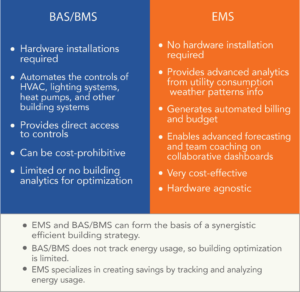
Image source: MACH Energy
Implementation is where good projects stall. It doesn’t have to be. A typical implementation process runs in four stages.
Typical timelines. An overlay deployment is often measured in weeks from signed agreement to live control. A full BMS replacement can take many months. Either way, plan for a full year of operation before judging seasonal performance.
The most important decision here isn’t technical. It’s deciding who handles the complexity. A provider that manages integration, tuning, and ongoing optimization for you turns a project into a service. One that hands you software and a login turns it into another job for your team.
Buy the outcome, not the homework.
Upfront price is the easiest number to compare and the least useful. Here’s what to measure instead.
Total Cost of Ownership (TCO). Add up hardware, installation, software subscriptions, integration, and ongoing service over the life of the system. A cheap platform that needs constant attention from your staff isn’t cheap.
Return on Investment (ROI) and payback period. Two simple formulas give you the shape:
Annual ROI ≈ (annual savings − annual cost of the system) ÷ total investment
Payback period (years) ≈ net upfront cost ÷ annual savings
Count all the savings, not just energy: avoided repairs, estimated demand response revenue, and avoided fines all belong in the total.
To make it concrete, take a hypothetical building spending $400,000 a year on energy. A 20% reduction is $80,000 a year. If the system costs $60,000 to install, simple payback lands at about nine months.
Guaranteed savings and SLAs. Projections are easy to promise. Ask whether savings are contractually guaranteed, and what happens if they fall short. Service Level Agreements (SLAs) should spell out response times and system uptime.
Reporting. Strong data collection and analysis should show measured savings against a verified baseline, not just energy usage charts.
Here’s what verified results look like. At a 24-floor, 288-unit Manhattan rental building, savings were guaranteed at $31,573. Actual year-one savings came in at $145,245, and a projected 1.77-year payback shrank to an actual 10 months. The building also cut its potential LL97 fine exposure by $94,854.
Curious what that math looks like for your building? Contact us for a complimentary energy savings assessment.
A projection is a promise. A guarantee is a contract.
Every building manager has reservations. These are the four implementation challenges that come up most, and how to handle each.
“Our equipment is too old.” Legacy systems are the rule, not the exception. Most can be integrated through existing controllers or with added gateways and sensors. Insist on an audit that confirms compatibility before you sign anything.
“Residents will feel it.” Savings that cost occupant comfort don’t last. Set hard comfort limits up front, require the system to optimize inside them, and make sure you can see the temperature data that proves it.
“Is our data safe?” It should be. Cloud-based systems need encrypted connections, role-based access, and clear data-handling policies. Ask exactly where your data is stored, who can see it, and what the system can change on its own. Data security deserves the same scrutiny as any other building system.
“My team will push back.” Staff often worry that automation means oversights, or replacement. Bring them in early. The system is an extra set of eyes that handles the round-the-clock watching, so technicians spend their time fixing problems instead of hunting for them.
Notice the pattern: each challenge is solved less by software than by the partner behind it. That’s why Parity pairs control optimization software that runs your HVAC 24/7 with a team of engineers who tune it alongside your on-site staff.
The right partner turns objections into a checklist.
HVAC energy management is no longer a luxury. With utility costs volatile and building performance standards tightening every compliance period, it’s a necessity for cost control, compliance, energy efficiency, and your sustainability goals.
The real shift is from reactive problem-fixing to proactive management: preventing problems with data instead of chasing them after the complaint.
The Parity Optimizer is built for exactly that. It works with the systems already in your mechanical room (no retrofits, nothing inside units) to optimize energy consumption around the clock. On buildings like yours, we typically cut utility costs by up to 20–30%, with no upfront investment. And the savings are guaranteed, or we cut you a check for the difference.
Good facilities management shouldn’t mean chasing your systems. Let us take the daily work of HVAC performance off your shoulders.
Are you ready to save up to 20–30% in utility costs? Book a free energy savings assessment, and we’ll show you what your building could save before you commit to anything.
Reach us at contact@paritygo.com · 1-833-372-7489 · paritygo.com · See how demand response adds revenue.