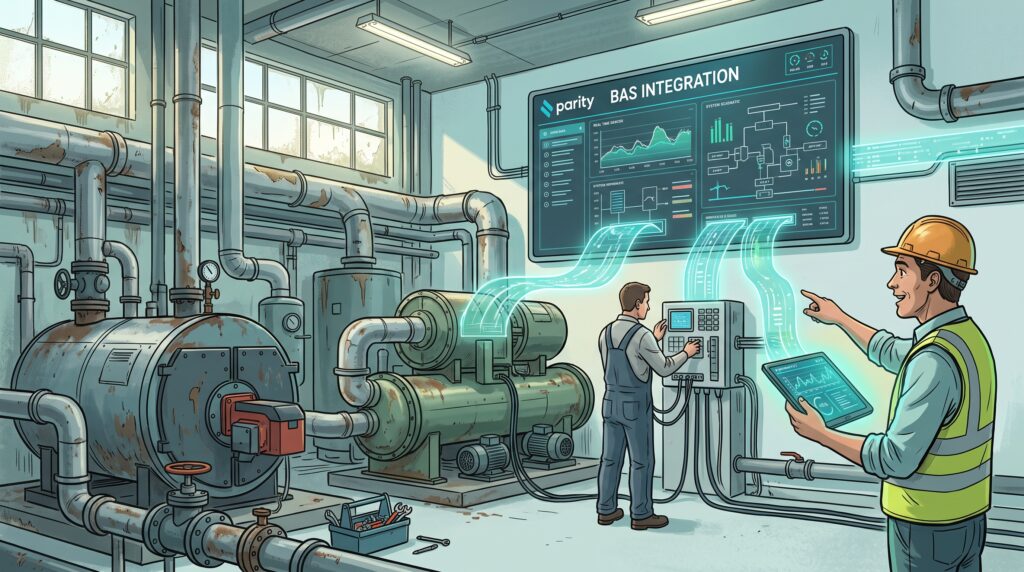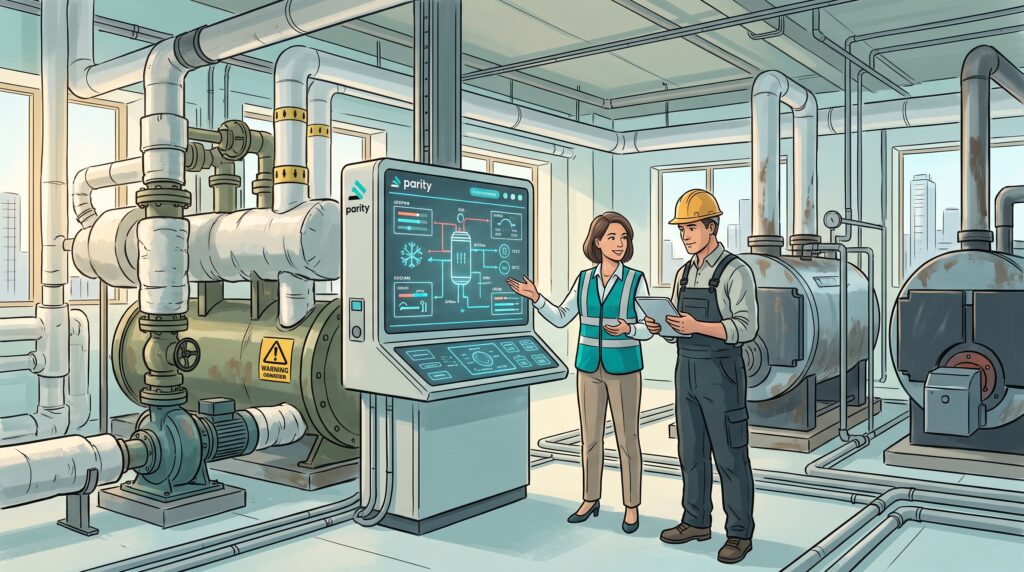
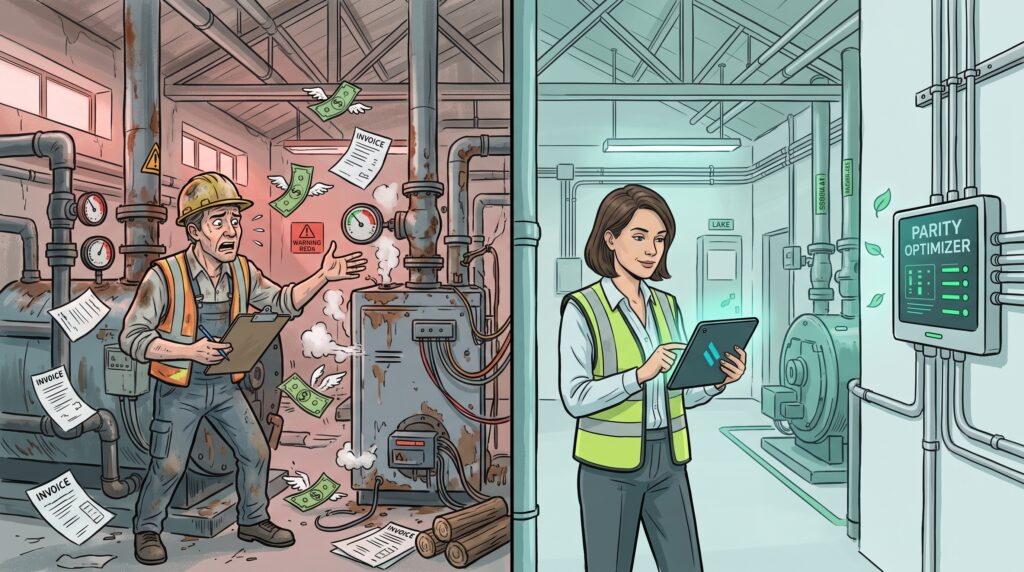
Is your building’s energy use something you manage, or something that happens to you?
For most operations teams, it’s the second.
Energy costs swing with the weather and the market. Local Law 97 (LL97) and similar building performance standards tighten on a fixed schedule. Owners want progress on sustainability, and residents and guests expect occupant comfort no matter what the boiler costs to run.
These pressures don’t arrive one at a time. They stack.
A building energy management system is built for exactly that stack. According to the U.S. Environmental Protection Agency (EPA), roughly a third of the energy used in commercial buildings is wasted.
A modern system goes after that waste directly. Not just monitoring it, but actively optimizing your equipment in real time. The strongest models go one step further and guarantee the savings.
Cost, regulatory compliance, comfort, and carbon share a root cause: energy used when and where it isn’t needed.
Fix that, and all four move in the right direction.
Here’s the plain BEMS definition: a Building Energy Management System (BEMS) is a technology-driven system that monitors, controls, and optimizes a building’s energy consumption.
It collects data from your equipment and meters, finds where energy is being wasted, and adjusts systems to eliminate that waste. You’ll also see it called an Energy Management System (EMS). The job is the same.
The confusion usually starts with a close cousin, the Building Management System (BMS).
A BMS runs the building. It’s a broad control platform for many building functions: HVAC, lighting, security, fire safety, and access. Its job is to keep everything operating. It follows the schedules and setpoints someone programmed, often years ago, and it keeps following them whether or not they still make sense.
A BEMS runs the building efficiently. It’s a specialized layer focused on a single outcome: energy optimization. It typically sits on top of your existing BMS, reads the same equipment data, and uses advanced analytics and AI to improve on — or override — standard BMS operations whenever there’s a cheaper way to deliver the same comfort.
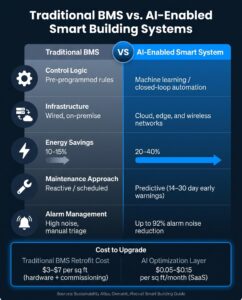
Image Source: iRecruit.io
Put simply, a BMS answers “Is the system running?” A BEMS answers “Should it be running like this?”
In multifamily buildings and hotels, HVAC is where that second question matters most.
It’s usually the largest energy load in the building, which makes it the largest opportunity.
You rarely have to choose between the two. The BMS keeps the building running; the BEMS makes sure you aren’t paying for more than you need.
Every BEMS runs the same four-step loop. The difference between a good one and a great one is how well it handles the last two steps.
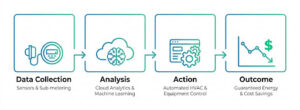
This is also why simple scheduling hits a ceiling. A schedule assumes every Tuesday looks the same. Weather, occupancy, and energy prices don’t cooperate.
The savings don’t come from one big adjustment. They come from thousands of small, correct decisions made around the clock — decisions no operations team has the hours to make by hand.
Most feature lists start to look alike. Sort them into three categories and the gaps show up fast.
Monitoring & analytics. This is the foundation of energy monitoring: real-time dashboards, historical trend reporting, and utility bill analysis that compares what your meters recorded against what you were billed. Insist on weather-normalized baselines. Without them, you can’t tell whether savings came from the system or from a warm winter.
Automated control. This is the category that separates a BEMS from a reporting tool. Look for intelligent scheduling, setpoint optimization, and Demand Response (DR) automation — where the system curtails load during grid peak events without anyone on site pressing a button. Good building energy management software makes these adjustments on its own, within comfort limits you set.
Integration & intelligence. Look for cloud services connectivity, so the system can be monitored, updated, and supported remotely without on-site servers. Check for Internet of Things (IoT) device compatibility, so wireless sensors and smart meters can be added as needed. And require Fault Detection and Diagnostics (FDD): fault detection that flags failing equipment early and names the likely cause, which is the backbone of predictive maintenance. Open data access is a plus, too, so energy data can flow into the reporting tools you already use.
One capability rarely shows up on a spec sheet, but it matters most: who responds when the system flags something at 3 a.m.? If the answer is “your super, tomorrow morning,” the feature list only tells half the story.
Use these three categories as your checklist. If a platform is strong on monitoring and thin on control, you’re looking at a very good report — not an energy management system.
Visibility tells you what went wrong. Control keeps it from happening again.
Every BEMS conversation lands on the same question: what does it cost, and when does it pay for itself?
Start with the savings side. A well-run system commonly reduces energy use by 15–30%, depending on the building and how efficiently it runs today. But energy is only one line in the value calculation. A complete picture of annual cost savings includes:
Then put it into two simple formulas:
Simple payback period (years) = net upfront cost ÷ total annual savings
Annual Return on Investment (ROI) = (total annual savings − annual system or service fees) ÷ upfront investment
Here’s a hypothetical example. A 200-unit residential building spends $500,000 a year on utilities. A 20% reduction saves $100,000 a year. If the system costs $150,000 to install, the payback period is 1.5 years. Most BEMS projects pay back within one to three years, and real-world results can beat projections by a wide margin.
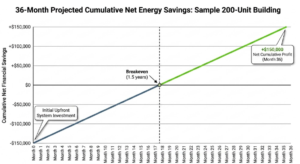
Two traps to avoid.
First, a projection is not a result. Ask exactly how savings will be measured, against what baseline, and whether they’ll show up on your actual utility bill.
Second, the sticker price is not the full cost. Factor in the staff time needed to act on what the system finds. A tool that saves energy but adds hours to your team’s week gives back part of its operational efficiency gains.
The best ROI isn’t the biggest projected number. It’s the one you can verify on your utility bill.

Energy you don’t use is carbon you don’t emit. That makes a BEMS a sustainability tool as much as a financial one.
Decarbonization you can prove. Every kilowatt-hour and therm a BEMS cuts reduces your building’s carbon emissions and overall footprint. Just as important, the system measures that reduction. When owners, investors, or lenders ask for progress on Environmental, Social, and Governance (ESG) goals, you can hand them metered data instead of estimates.
Compliance with building performance standards. Local Law 97 is the clearest example. It sets greenhouse gas emissions limits for most New York City buildings over 25,000 square feet. Buildings that exceed their limit face fines of $268 per metric ton of carbon dioxide equivalent over the cap, and the limits tighten significantly in 2030. Boston’s Building Emissions Reduction and Disclosure Ordinance (BERDO) and Washington, DC’s Building Energy Performance Standards (BEPS) follow a similar model. If you manage in New York, you can estimate your building’s LL97 exposure in a few minutes.
A BEMS supports compliance in three ways:
Many cities also require annual energy benchmarking through the EPA’s ENERGY STAR Portfolio Manager. A BEMS keeps that data complete and consistent, so the filing reflects your real energy efficiency progress.
There’s a practical point here, too. Most buildings can’t electrify or replace major equipment overnight. Operational optimization is the fastest, lowest-cost emissions cut available while longer-term capital plans catch up.
Reporting tells the city where you stand. Reduction changes the number.
This is the model Parity built its Optimizer service around: active control of the HVAC systems you already have, managed by a team of engineers, with guaranteed savings — or we cut you a check for the difference.
At Avalon Clinton South, a 24-floor, 288-unit Manhattan rental, the contracted guarantee was $31,573. Actual year-one savings came in at $145,245, with a 10-month actual payback against a 1.77-year projection.
Don’t buy the dashboard. Buy the outcome — and make someone sign for it.
BEMS implementation sounds like a construction project. Done well, it’s much closer to a software rollout.
Don’t skip cybersecurity. Any connected building system is a potential entry point, so treat it like one. Ask each vendor:
A vendor with strong answers will be glad you asked.
The hardest part of implementation isn’t technical. It’s choosing a partner who’s still paying close attention in year three.
For most mid-to-large multifamily buildings and hotels, a BEMS investment isn’t a cost. It’s an investment in building efficiency, compliance, and future-readiness. A well-chosen building energy management system delivers cost reduction you can measure, year after year.
To pressure-test it for your property, look at three things: your annual utility spend, your operational pain points (comfort complaints, manual adjustments, the 2 a.m. calls), and your regulatory risk under LL97 or a similar law. If any of the three keeps you up at night, the case is already strong.
So the real question isn’t whether to adopt smart building technology. It’s which BEMS model will deliver the most reliable return.
Parity’s answer is an active optimization partner. We control and optimize HVAC systems 24/7 in multifamily buildings and hotels, delivering up to 20–30% in utility cost savings with no upfront investment and nothing installed inside units. We also add revenue through automated demand response. The savings are guaranteed — or we cut you a check for the difference.
Are you ready to save up to 20–30% in utility costs? Book a free energy savings assessment and we’ll show you the number before you commit to anything. Or see how our Optimizer service works.
Contact us: contact@paritygo.com · 1-833-372-7489 · paritygo.com