If your team still adjusts setpoints by hand, walks the mechanical room every morning, and hears about problems when a resident calls, you’re not alone. You’re also paying for it.
HVAC automation is the use of intelligent technology to control a building’s heating, ventilation, and air conditioning with minimal human intervention. Instead of fixed schedules and manual tweaks, sensors and software monitor conditions around the clock and adjust your HVAC systems in real time.
The goals are simple: maximize energy efficiency, protect occupant comfort, and cut operating costs.
Traditional climate control is reactive. Something drifts, someone notices, someone fixes it. HVAC automation systems are proactive. They respond to weather, occupancy, and energy prices before those turn into a spike on the utility bill or a complaint at the front desk.
That matters more every year. Utility rates stay volatile, and building performance standards like New York City’s Local Law 97 (LL97) now put a price on every ton of carbon a building emits.
A thermostat holds a number. Automation manages a building.
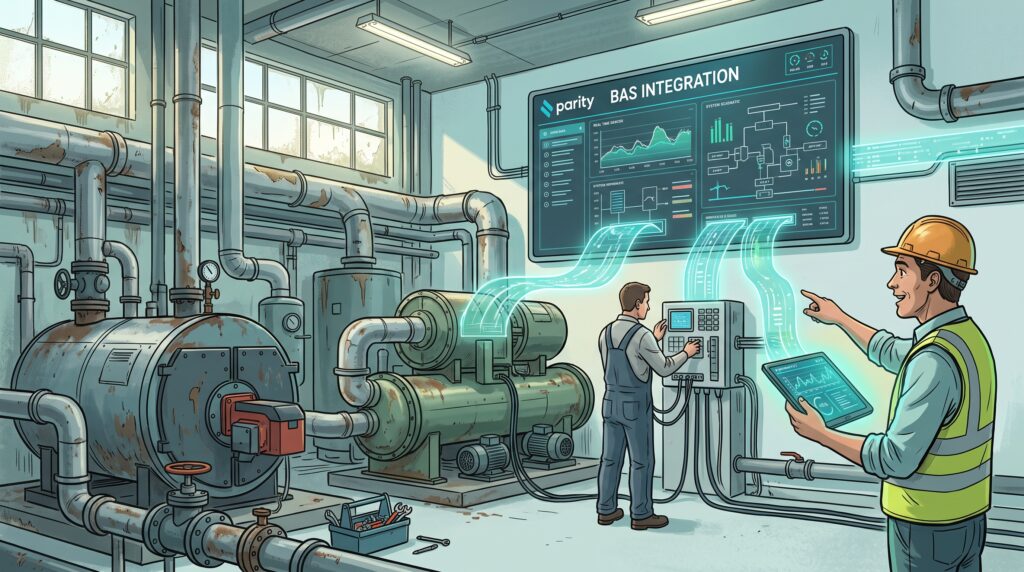
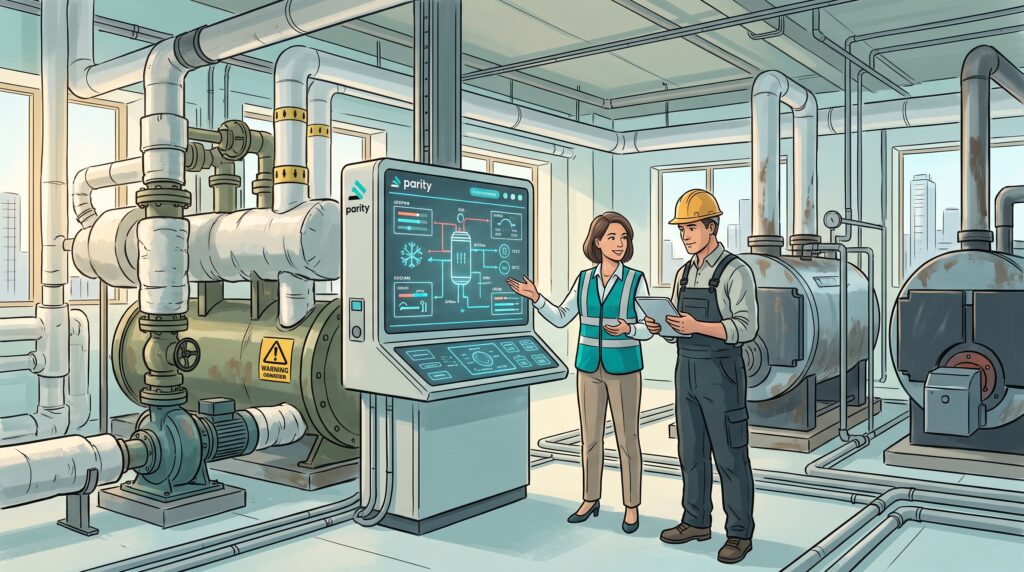
At the center of every automated setup is a Building Automation System (BAS), also called a Building Management System (BMS). The terms are used almost interchangeably.
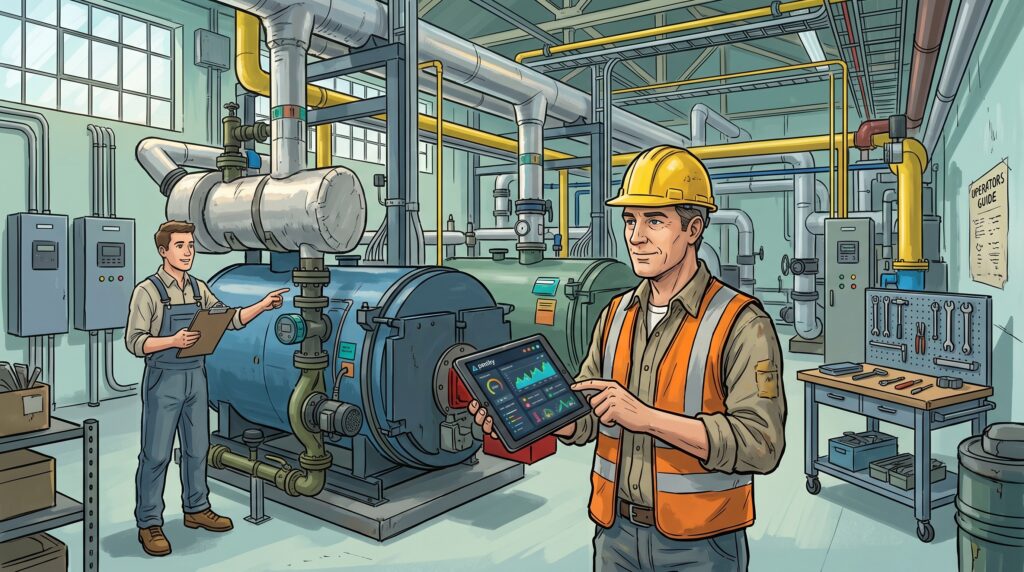
Both describe a centralized, computer-based network that monitors and controls a building’s mechanical and electrical equipment: boilers, chillers, cooling towers, pumps, fans, and more. Think of it as the brain of an HVAC building automation system. It does three core jobs.
Data collection. The BAS pulls readings from sensors and equipment across the building, such as supply and return temperatures, valve positions, fan speeds, and run hours, and logs them continuously.
Real-time adjustments. When conditions change, the BAS sends commands to the equipment. Supply water temperature eases as a winter afternoon warms up. A fan slows when a space empties out.
Scheduling. The BAS runs equipment on programmed calendars, including morning warm-up, overnight setbacks, and seasonal changeovers, so nobody has to flip switches by hand.
Those controls are what move a building beyond simple on/off. Instead of equipment that runs flat-out or not at all, you get equipment that modulates to match demand.
Here’s the catch most managers discover: a BAS is only as smart as its programming. Many were configured once at commissioning and have run the same sequences ever since, while the building, its occupants, and its energy prices changed around them.
The BAS is the platform. What runs on it determines the result.
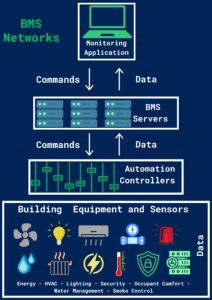
Image source: CIM.io
A BAS can’t control what it can’t see. Sensors are its eyes; actuators and controllers are its hands.
Temperature sensors. The workhorse. Placed in spaces, ducts, pipes, and outdoors, they tell the system whether it’s hitting setpoints and how fast conditions are changing. Outdoor readings let the system anticipate load instead of reacting to it, like easing boiler output on a mild winter morning.
Humidity sensors. High humidity makes a space feel warmer than the thermostat says and invites mold. Low humidity drives dryness complaints. With humidity data, the system dehumidifies only when needed instead of overcooling to compensate.
Carbon dioxide (CO2) sensors. CO2 is a proxy for how many people are in a space. That enables demand-controlled ventilation: more fresh air when a ballroom or amenity room fills up, less when it’s empty. Every cubic foot of outdoor air you don’t need is air you don’t have to heat or cool.
Occupancy sensors. Motion or presence sensors tell the system whether a space is in use. When a hotel meeting room or residents’ gym sits empty, airflow and setpoints relax automatically.
Controllers and actuators. Controllers are the local decision-makers that run each piece of equipment based on BAS instructions. Actuators do the physical work: opening and closing valves, moving dampers, and changing fan speeds. Together, this layer is what the industry calls HVACR controls.
One thing the spec sheets won’t tell you: smart technology is only as good as its data. A miscalibrated sensor quietly feeds bad information into every decision downstream, so checking sensor accuracy belongs on every maintenance plan.
Sensors don’t save energy. Decisions based on sensors do.
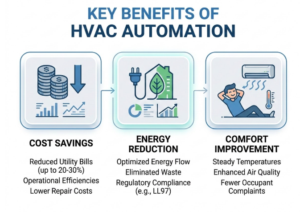
For a building manager, automation earns its keep in four ways.
Together, these benefits support broader sustainability goals. Every kilowatt-hour and therm you don’t use is carbon you don’t emit.
Cost, compliance, workload, comfort: one system moves all four.
Traditional HVAC control relies on people and fixed schedules. Automated control relies on data. The equipment can be identical; what changes is who, or what, makes the decisions and how often. Here’s how that plays out day to day.
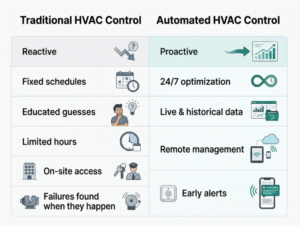
None of this sidelines your team. Smart solutions take over the repetitive, round-the-clock watching so your people can focus on repairs and judgment calls.
Manual control asks your team to be everywhere at once. Automation doesn’t.
Implementing HVAC automation doesn’t have to start with a construction budget. For facility managers, here’s a practical roadmap.
Then run the simple math: simple payback (years) ≈ net upfront cost ÷ total annual savings.
When you compare options, ask one plain question: what happens if the savings don’t show up?
Curious what your building could save? Contact us for a complimentary energy savings assessment.
Every connection that makes remote management possible is also a door. Connected HVAC systems sit on your building’s network, and attackers know it.
This isn’t hypothetical. One of the most widely reported U.S. retail data breaches started with network credentials stolen from an HVAC vendor.
The risks fall into two buckets.
Unauthorized access. An exposed BAS can become an entry point to other systems on the same network, including ones that hold resident or guest data.
System manipulation. An intruder with control could change setpoints, shut down equipment, or silence alarms, creating comfort problems, equipment damage, or safety issues.
The good news: sound cybersecurity for smart buildings comes down to a few disciplined habits.
Separate the network. Keep building systems on their own segmented network, never on the same one as guest Wi-Fi or office computers.
Keep software current. Apply firmware and software updates for controllers and the BAS on a regular schedule.
Enforce strong access control. Replace default passwords, give every user a unique login, and remove access the day staff or contractors leave.
Choose vendors who take security seriously. Ask exactly how your data is transmitted and stored, who can reach your systems, and how that access is logged.
Security isn’t a reason to avoid automation. It’s a condition for doing it right.
Traditional automation follows rules someone wrote years ago. The next generation learns better ones.
AI and machine learning. Machine Learning (ML) models study how your building actually behaves: how fast each zone loses heat, how occupancy shifts by hour and season, how the building reacts to a cold front. With that thermal profile, AI can pre-heat or pre-cool at exactly the right moment instead of following a generic schedule.
Predictive maintenance. Instead of servicing on a fixed calendar or waiting for a pump to fail, the system watches for subtle signs of wear, such as rising motor current, longer cycle times, or drifting temperatures. Your team gets an alert naming the likely cause before the breakdown, which cuts downtime and repair costs.
Internet of Things (IoT). Affordable connected sensors and devices make all this practical, feeding far more data into the system than a traditional BAS was built to handle.
Agentic automation. This is the next step. An agentic system doesn’t just flag a problem or recommend a fix. It works toward a goal, such as minimizing cost while holding comfort, decides how to get there, acts, and checks the result, continuously. People set the boundaries and handle the physical work. The system handles the constant tuning in between, which is how unified HVAC management empowers building operators rather than replacing them.
This is where intelligent buildings are headed: from systems that follow instructions to systems that pursue outcomes.
And you don’t need new hardware to start. You need smarter control of the equipment you already have.

HVAC automation is no longer a luxury. For multifamily buildings and hotels facing volatile utility costs and tightening carbon limits, it’s a core tool of modern building management: lower costs, a stronger compliance position, and a lighter load on your team.
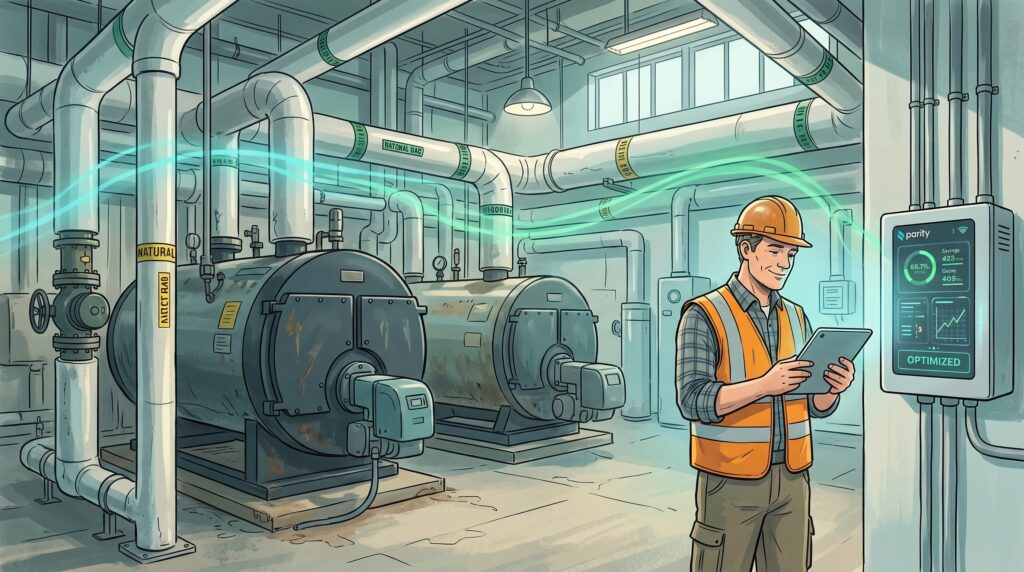
Here’s what that looks like in practice. At 252 East 57th Street, a luxury Manhattan condo and rental building, Parity’s Optimizer Service automated control of the boilers, cooling tower, pumps, and ventilation. Year one:
That’s the service-based approach at work. The Optimizer builds on your existing systems (no retrofits, nothing inside units) with zero upfront investment. Parity’s team micromanages your HVAC around the clock, and the savings are guaranteed, or we cut you a check for the difference.
Automation is fast becoming the standard for high-performing, profitable properties, and a direct path to decarbonization and better building performance.
Are you ready to save up to 20–30% in utility costs? Learn more about Parity’s Optimizer Service or book a free energy savings assessment.
Reach us at contact@paritygo.com · 1-833-372-7489 · paritygo.com.