
2025 marked a significant year for real estate.
Across the United States, rampant concerns about rising utility rates, grid instability, and the imposition of building decarbonization fines kept property owners and operators on their toes.
Multifamily and hotel buildings were no exception.
Propmodo predicts a multifamily recession in 2026, and CoStar reported that for the first time since 2020, hotel occupancy and revenue per available room saw a decline in 2025.
Revenues are expected to decline while costs are skyrocketing, leaving bottom lines in the danger zone.
Whether it’s New York or California, a rental or hotel, building staff need to be aware of curveballs headed their way so that they can stay ahead of them.
Runaway utility rates have been the central topic of concern in recent months.
Distress over rising energy costs has grown so substantial that multiple gubernatorial and mayoral races across different states ran on, and won, platforms vowing to fight back against these rising rates.
For example, a Utility Dive article covering the newly elected governor of Virginia, Abigail Spanberger, D, and her administration’s focus on clean energy and energy affordability cites, “Governor-elect Spanberger and fellow Democrats outlined their strategy agenda last month, emphasizing the need to lower costs.”
Across state lines and sectors of real estate, the burden of rising utility rates is hitting everyone hard.
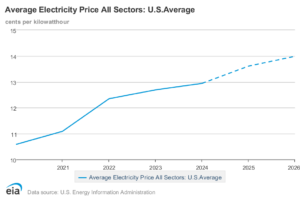
Image Source: The EIA, Average Electricity Price All Sectors: U.S. Average
However, residential real estate seems to be taking the worst hit.
According to the EIA, the national average residential price per kilowatt hour in 2026 is 18 cents, a 37% increase since 2020.
Simply put, properties are spending 37% more on utility costs for the same amount of consumption.
Overall, according to Utilities Dive, “…regardless of how increases compare with overall inflation, residential rates have risen faster than those for commercial and industrial customers, shaping public perceptions about fairness.”
For multifamily buildings and hotels, where HVAC systems represent a significant portion of operational expenses, rising utility rates can severely impact budgets and bottom lines.
Building owners and operators have to seek out intelligent solutions to optimize their energy consumption.
This isn’t about turning down thermostats; it’s about implementing sophisticated systems that learn, adapt, and predict energy needs based on your building.
By reducing unnecessary energy waste, buildings can mitigate the impact of rising utility rates and free up resources for other critical investments.
As our energy infrastructure ages and demand grows, grid instability is becoming a more frequent issue.
Some areas struggle with grid instability more than others. This is especially true for areas where data centers are expected to be built.
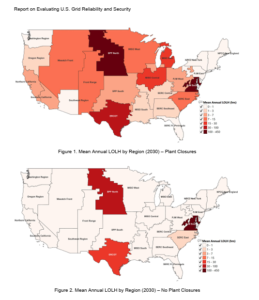
Image Source: GridBeyond, US grid reliability and security at risk, warns DOE
Increasing demand, coupled with data center load requirements, adds an unprecedented amount of weight added to an already strained grid.
Unfortunately, the grid is arguably one of the most inflexible structures. It takes a huge amount of time, planning, and capital to build up to boost its transmission capacity.
This solution could take years and, in that time, have already caused blackouts or failures, leading to disruptions in building operations and disgruntled residents or guests.
The root of the problem is too much necessity, too little capacity.
In 2026, a central focus will be on maximizing the use of existing infrastructure and squeezing out every bit of existing capacity.
Demand response programs incentivize large energy consumers, like multifamily buildings and hotels, to reduce their energy usage during peak demand periods.
Participating in demand response offers a win-win scenario; buildings earn financial incentives for shedding load when the grid is stressed, while simultaneously contributing to grid stability and reliability.
Optimizing HVAC systems allows multifamily buildings and hotels to turn into Grid-Interactive Efficient Buildings (GEBS) that earn revenue from program payouts.
Buildings need HVAC systems that can intelligently adjust energy consumption without compromising occupant comfort.
This proactive approach to energy management will be crucial for both financial gain and operational resilience.
The push for a greener future is intensifying, and with it, a wave of building decarbonization laws is sweeping across regions.
Building decarbonization standards like NYC’s Local Law 97 (LL97), Boston’s Building Energy Reporting and Disclosure Ordinance (BERDO), and the DMV’s Building Energy Performance Standards (BEPS) are setting stringent limits on carbon emissions from existing buildings.
While the focus of these building decarbonization ordinances strives for greater sustainability in residential real estate, they carry significant financial implications that affect properties, including hefty fines for non-compliance.
They necessitate a fundamental rethinking of building operations, particularly HVAC systems.
Older, inefficient HVAC systems are major contributors to carbon emissions.
To comply with building decarbonization regulations and avoid penalties, buildings must invest in modernization and optimization.
Retrofitting building equipment can take years for approval and installation, and requires massive capital expenditure.
Optimizing existing HVAC systems is a quicker solution that promises faster returns and complies with building decarbonization standards in the near term.
Properties can benefit from reduced CO2 emissions from HVAC systems consuming less energy, translating to reduced fines from building performance standards.
However, compliance with local laws is only one part of the story.
The necessity for building decarbonization reaches beyond the need to operate more sustainably; it enhances the operational efficiency of their buildings, improves their market value, and attracts environmentally conscious tenants, guests, and investors.
Managing a multifamily and hotel building is growing increasingly complicated.
Property management has shifted from overseeing operations to actively sourcing the most efficient ways of operating buildings while producing maximum value.
With trends pointing toward declining occupancy rates in both multifamily properties and hotels, getting smart with securing bottom lines against costs and fines is the only way to survive.
The challenges of 2026—rising utility rates, grid instability, and building performance standards—are significant, but so are the opportunities for those who adapt.
With trends pointing toward declining occupancy rates in both multifamily properties and hotels, getting smart with securing bottom lines against costs and fines is the only way to survive.
The challenges of 2026—rising utility rates, grid instability, and building performance standards—are significant, but so are the opportunities for those who adapt.
HVAC optimization as a service provides a comprehensive solution, enabling multifamily buildings and hotels to navigate these threats successfully.
By leveraging advanced analytics, intelligent controls, and expert insights, buildings can:
525 West 52nd Street, a 24-floor luxury rental building in Manhattan, New York, was facing rising utility rates, high energy consumption, and looming LL97 fines.
With the optimization of the building’s water-sourced heat pumps that provided central heating and cooling, the building was projected to save at least $39,848 in guaranteed utility costs in its first year working with Parity.
Performance outdid projections, and we delivered $67,702 in utility cost savings. That’s 1.6x more in achieved savings than was predicted.
No expensive retrofits or proprietary hardware—only existing HVAC systems being optimized.
The optimized HVAC systems prevented 42 tons of CO2 emissions, translating to $11,148 saved from potential LL97 fine exposure.
To top it off, Parity automated demand response curtailment, generating $15,000 in demand response revenue.
All in all, 525 West 52nd was able to contribute over $90,000 toward the property’s bottom line, which would have otherwise been expended on unnecessary costs and fines.
During a time of unprecedented rising energy costs and building decarbonization fines, “every dollar counts,” says Andrew Schwartz, Senior VP of Residential Asset Management at Taconic Partners.
The future of energy efficiency is here, and it’s smart, sustainable, and optimized.
To learn more about how Parity’s HVAC optimization service can help achieve utility cost savings and reduce fines from building performance standards, contact contact@paritygo.com or call 1-833-372-7489.
The energy landscape is evolving. According to a report from PowerLines, utility costs are rising faster than inflation.
In the first half of 2025, U.S. utility companies requested $29 billion in utility rate hikes, affecting over 40 million customers. Residential electricity costs have risen by almost 30% since 2021, and residential gas costs have increased by nearly 40% since 2019, according to the U.S. Energy Information Administration (EIA).
These aren’t short-term adjustments. They signal a lasting shift in how electricity is generated, delivered, and priced, making planning building operations around utility rate hikes essential for controlling long-term costs.
More than ever, building managers need to think like grid operators to stay ahead of rising utility costs. 3 main forces are accelerating the rate of increase across the country:
For buildings with outdated HVAC systems, the pressure is mounting. Old systems were built for a predictable grid, not one strained by extreme heat and surging demand. What was once focused on comfort must now respond to volatility.
As rates rise, failing to plan building operations around utility rate hikes only increases the cost of inaction. Every month a building operates without adjusting to today’s energy landscape, it takes on more financial risk. Peak pricing, capacity charges, and seasonal volatility can quietly add thousands to utility costs.
In regions like New York and California, a single high-demand event can define a building’s peak load for the year, triggering monthly charges long after the moment has passed. Buildings that lack real-time responsiveness or seasonal strategies, the foundation of planning building operations around utility rate hikes, have no way to defend themselves from these costs.
Yet many still operate under outdated assumptions. They treat energy as a fixed overhead, rather than a variable cost shaped by timing and behavior. That mindset worked when the grid was simpler. But today, utilities don’t just charge for how much energy you use. They charge for when and how you use it.
Staying passive in the current energy environment is no longer safe. It’s a financial decision (or lack thereof) that exposes buildings to risk they can’t see until the bill arrives. And those bills are only getting bigger.
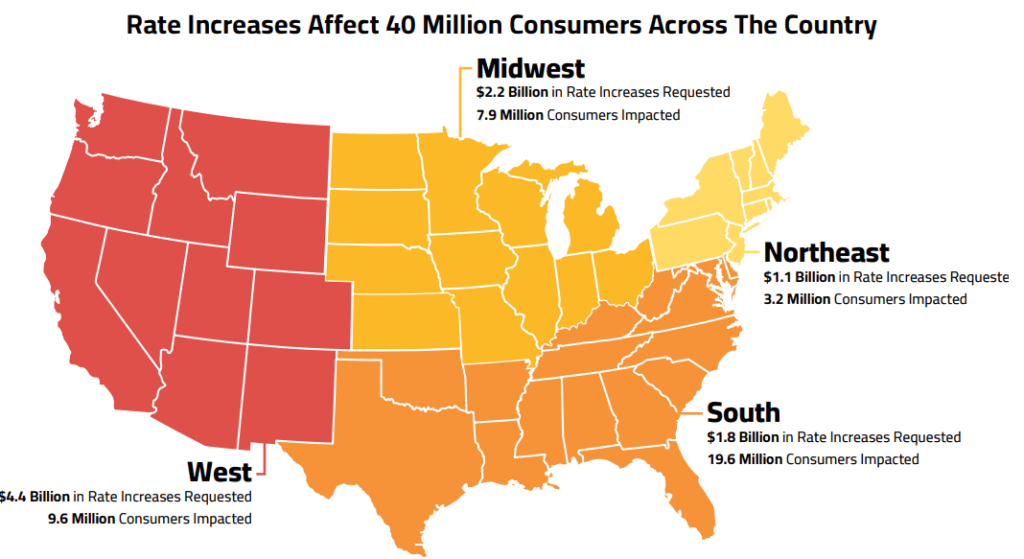
Image credit PowerLines
Grid operators are not passive energy users. They anticipate demand, monitor real-time conditions, and adjust proactively to prevent system strain. Building managers must adopt that same proactive mindset if they want to effectively plan building operations around utility rate hikes.
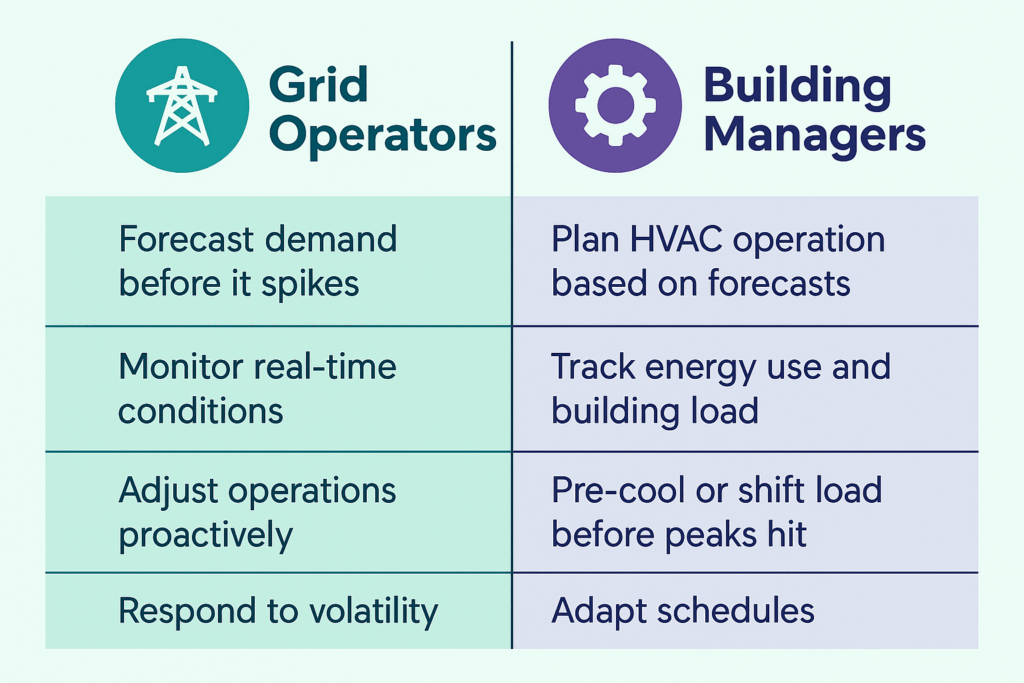
The more volatility the grid experiences, the more that volatility is priced into every kilowatt-hour a building consumes.
Utilities have shifted significant responsibility downstream. Charges based on peak usage, demand intervals, and seasonal load profiles signal that buildings are expected to manage not just consumption, but impact. The rules have changed, and buildings that do not adapt will continue to pay a premium.
This shift calls for a new operating mindset. One where building teams don’t just react to bills but work to understand what’s driving them. That means identifying the building’s peak load moments, anticipating when the grid will be most stressed, and aligning HVAC operation accordingly.
A grid operator would never walk into a heatwave blind. A building shouldn’t either. Especially when planning building operations around utility rate hikes, protecting both budgets and comfort.
Parity helps multifamily buildings and hotels plan operations around utility rate hikes without relying on guesswork, spreadsheets, or reactive strategies. Our service automates demand response protocols to avoid unnecessary peak demand charges, reduce exposure to capacity charges, and smooth out volatility in energy spend, without sacrificing tenant comfort.
In late June 2025, a record-setting heatwave hit the Northeast and Mid-Atlantic, sending grid operators scrambling to maintain stability. Electricity prices in places like New York City surged above $2,400 per megawatt-hour. Parity supported our customers by automatically adjusting HVAC setpoints and load schedules in the hours leading up to the forecasted peak.
The result was twofold. First, the contributions of those buildings added up to 300kW per day, or roughly the real-time electricity demand of about 250 homes. Second, we helped those buildings avoid costs not just for the day, but for the months that followed.
Our customers were able to support local grid operators in maintaining stability during a time of need while simultaneously turning a stressful event into a source of revenue.
To learn more about how HVAC optimization can help control utility costs and improve energy strategy, email contact@paritygo.com or call 1-833-372-7489.
Building Performance Standards like NYC’s Local Law 97, Boston’s BERDO, and the DMV’s BEPS aren’t going anywhere. And they’re only growing stronger.
A three-year legal challenge by two co-ops to overturn NYC’s Local Law 97 was just dismissed by the state’s highest court on May 22, 2025, sending a clear message to property managers that building performance standards are here to stay.
Building performance standards are designed to curb greenhouse gas emissions and improve energy efficiency in large buildings. While they differ across cities, their core goals are the same: reduce carbon emissions, modernize building operations, and help cities meet ambitious climate targets.
Legal and Political Pushback
The rollout of building performance standards hasn’t been without resistance.
There have been legal challenges, including a high-profile lawsuit from two co-ops seeking to block the law entirely. That suit was dismissed by the state’s highest court in May 2025, reinforcing that Local Law 97 is here to stay.
However, the deadline for the first round of Local Law 97 compliance reporting was extended from May 1st to August 29th, with an option to file for extension to December 31, 2025, giving buildings more time to prepare.
In Washington, D.C., similar tension is playing out. The Mayor’s proposed FY2026 budget calls for significant delays to the city’s Building Energy Performance Standards (BEPS). The first compliance deadline, originally set for 2026, would be pushed back to 2032.
Future BEPS cycles would also be delayed, and related net-zero energy requirements could be postponed until 2045. While these proposals are not yet finalized and still require Council approval, they’ve created real uncertainty for building owners, operators, and service providers across the District.
Boston, by contrast, is staying the course. Under BERDO 2.0, large buildings are already required to report their emissions, and emissions caps are set to start phasing in by 2025 for many property types. The city has also committed to releasing detailed enforcement guidance and penalty structures, signaling that BERDO compliance is moving forward as planned.
Despite differing timelines, the overall direction is consistent. Cities remain committed to cutting emissions, and building performance standards continue to be the tool they’re using to get there.
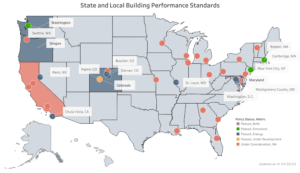
Source: energycodes.gov/BPS, April 2024
Why Building Performance Standards Still Matter
It’s easy to get caught up in shifting deadlines and legal battles. But at their core, building performance standards is about something more permanent: accountability.
These policies are forcing the real estate industry to confront energy use and emissions in ways that are measurable, transparent, and tied to real outcomes. Whether your city is slowing down or doubling down on building performance standards, the inevitable outcome remains the same.
Also, models like New York’s “Good Faith Efforts” approach, where buildings that aren’t fully compliant can reduce penalties by demonstrating real planning and progress, are emerging as a template for how enforcement might evolve across other cities, too.
Building performance standards will redefine what it means to operate a high-performing building by rewarding the buildings that take action and penalizing those that don’t.
The Practical Path Forward
So what does meaningful, proactive compliance look like in practice?
It starts with understanding your building’s performance. You can’t improve what you haven’t measured, which is why an energy audit is the critical first step.
This step is about understanding how your building truly performs: where energy is being wasted, where systems are falling short, and where opportunities are. Done right, this sets the foundation for everything that follows.
Once you know your baseline, prioritize smart, high-impact upgrades that make sense both financially and operationally. The most successful strategies don’t rely on major capital projects from day one. Instead, they focus on getting more out of what you already have. That could mean:
These actions are cost-effective and build momentum. They demonstrate intent, show progress, and create early wins that are easy to communicate to boards, tenants, and regulators.

Documentation matters just as much as implementation. A well-documented process showing audits, vendor proposals, completed scopes of work, and performance improvements provides evidence of compliance.
In cities like New York, that’s what qualifies as a “good faith effort.” But even beyond compliance, it becomes your case for future investment and board buy-in.
The takeaway is clear for building owners and managers across the U.S: timelines may shift, but the expectation to act remains firmly in place.
The Parity Difference
Parity makes the process of navigating building performance standards smoother. Our HVAC optimization service integrates with your existing systems to reduce energy usage and emissions while providing clear, actionable data. Comprehensive reports simplify compliance documentation and show your building’s path forward.
Learn how Parity can help your building stay ahead of the curve. Visit our website to discover how Parity helps buildings reduce GHG emissions to meet building performance standards without ripping and replacing equipment.
Or, email contact@paritygo.com or call 1-833-372-7489 to see if your building is a good fit for our services.
The landscape of property management is quickly evolving. Energy prices are rising, emission caps are tightening, and buildings that once coasted on predictable energy budgets are finding themselves exposed.
As grid strain intensifies and energy prices become more volatile, one thing is clear: the old way of managing HVAC systems is no longer economically viable.
This shift demands a change in mindset on how we think about utility costs. If you’re serious about cutting utility costs, you have to start with the system that drives most of them.
In most large residential buildings, the biggest opportunity for cost reduction is hiding in plain sight – your HVAC systems.
When buildings need to cut utility costs, they often start with what’s visible: swapping light fixtures, upgrading thermostats, etc. These efforts help, but they miss the bigger picture.
The largest share of utility costs in most residential buildings isn’t lighting or plug loads. It’s HVAC.
Heating, cooling, and ventilation systems operate continuously, reactively, and often inefficiently. They’re the foundation of a building’s energy profile and the source of the greatest waste.
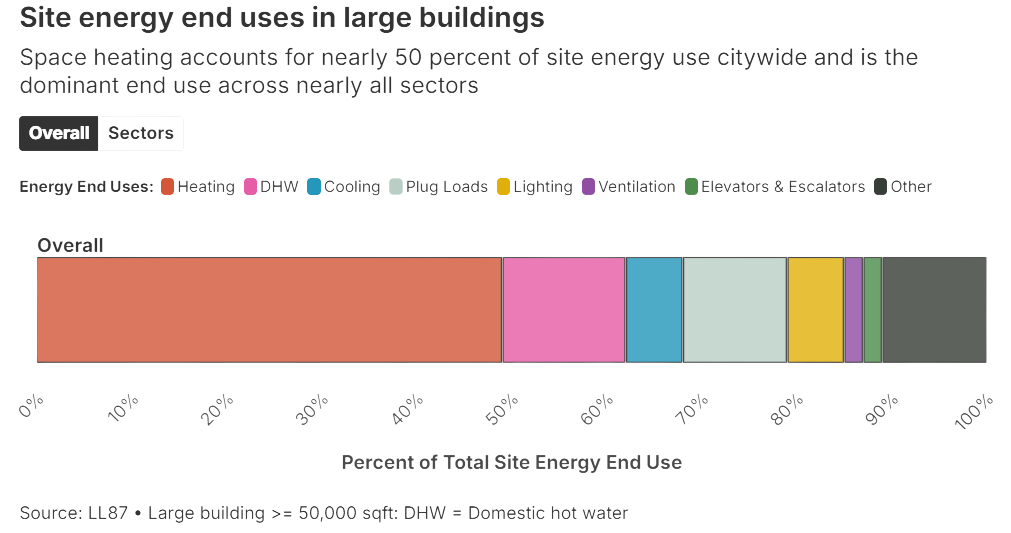
Source: Urban Green Council
Unlike traditional efficiency upgrades that focus on hardware replacement or marginal improvements, HVAC optimization doesn’t only address what consumes energy, it addresses how energy is consumed. It does this through intelligent software that can:
And it does all this without having to tear out existing equipment. Because HVAC optimization, like Parity’s Optimizer service, is software-based and hardware-light, it builds on your existing systems without having to replace them.
The financial impact of HVAC optimization is immediate, measurable, and substantial. By aligning HVAC operation with real-time demand, weather, and utility pricing, buildings reduce both total energy consumption and costly peak demand charges.
When executed properly, the benefits of HVAC Optimization are pretty easy to see: they show up directly on utility bills, often within the first few billing cycles.
Beyond the utility bill, these results translate into fewer emergency repairs, longer equipment lifespans, and progress toward emissions compliance. In several cases, optimization also unlocked participation in demand response programs turning HVAC from a cost into an asset.
Parity helps buildings save on utility costs through real-time HVAC optimization – guaranteed.
At 252 East 57th Street, a luxury condo in New York City, Parity delivered over $165K in first-year savings and achieved the full payback in only 8 months.
Across town, Avalon Clinton South, a 24-story rental building, saved more than $145K in energy costs within its first year, hitting their ROI in under 9 months.
Meanwhile, 401 East 86th Street, a 229-unit co-op, realized $107K in annual savings with a 2-month ROI.
If you want to learn more about how Parity is helping property and asset managers navigate energy efficiency and carbon fines, email contact@paritygo.com or call 1-833-372-7489.
Modern buildings generate massive amounts of data from HVAC systems, water usage, occupancy patterns, and more. But data alone isn’t enough. The key is to turn that data into actionable insights to improve efficiency, reduce costs, and enhance resident comfort.
That’s where data-driven HVAC optimization comes into play. By continuously monitoring a building’s HVAC performance and using real-time analytics, inefficiencies can be identified.
Maintenance needs can be predicted, and adjustments can be automated to save money and energy.
Heating and cooling systems are one of the largest energy expenses in residential buildings, often accounting for nearly 50% of total energy use. Without real-time monitoring, buildings may overheat, overcool, or run equipment inefficiently. That leads to wasted energy and unnecessary costs.
With data-driven HVAC optimization, buildings can reduce energy waste by utilizing software that makes automatic control adjustments based on real-time conditions.
Equipment lifespans can be extended by preventing overuse and catching small maintenance issues. Utility bills can be lowered when HVAC equipment only runs when necessary, rather than operating on outdated, fixed schedules.
At the same time, resident comfort remains a priority. Smarter controls can eliminate sudden fluctuations and uneven heating or cooling. That means fewer complaints from residents.
Traditional HVAC maintenance follows a fixed schedule or responds to failures after they happen. This means that systems may receive maintenance too late, after damage is done. Maintenance can be done too early, wasting time and resources.
Proactive maintenance changes the game by using real-time data and historical trends to detect subtle shifts in performance before a breakdown occurs.
By continuously analyzing HVAC data, predictive systems can flag equipment inefficiencies, prevent unexpected downtime, and reduce emergency repairs.
If a boiler starts running cold, ventilation system begins overworking, or a chiller shows signs of strain, building managers can take action before the problem escalates. This reduces maintenance costs, improves system reliability, and prevents disruptions for residents.
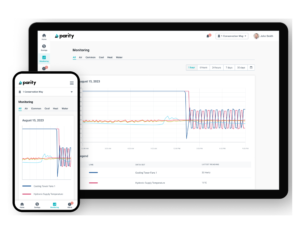
Parity remotely controls and optimizes HVAC systems to guarantee utility cost savings for multifamily residential buildings and hotels, with no upfront investment.
We help buildings reduce their energy waste, lower operational costs, and monitor their HVAC systems. By continuously monitoring HVAC systems, Parity can identify inefficiencies, optimize system performance, and send real-time alerts to building managers before issues become problems.
With Parity, buildings can:
By embracing real-time data and cutting-edge technology, buildings that work with Parity can unlock significant cost savings and long-term efficiency gains.
To learn more about how Parity is bringing advanced HVAC technology into the residential space, email contact@paritygo.com. You can also visit our website to learn more.
Property management is all about juggling priorities – keeping tenants happy, monitoring costs, and ensuring building operations run smoothly. But from what we’ve heard, HVAC systems can feel like the troublemaker of the group.
Breakdowns happen at the worst times, maintenance schedules get lost in the shuffle, and managing it all manually? Forget about it.
And it’s a big energy guzzler too. Roughly 40% of building energy consumption comes from HVAC systems. In multifamily buildings, nearly 1/3 of that is wasted.
That’s where HVAC optimization software steps in. And here at Parity, we believe we’ve perfected our service to make your life easier while helping your building’s systems work smarter, not harder. But more on that later.
HVAC optimization is the process of enhancing the efficiency, performance, and cost-effectiveness of heating, ventilation, and air conditioning systems. We previously wrote about HVAC optimization in more detail here.
Here are 3 reasons why Property Managers love HVAC Optimization Software.
Keeping energy costs under control is a constant battle for property managers, especially in multifamily buildings where usage can skyrocket.
HVAC optimization software helps you save big by slashing utility costs and reducing maintenance costs.
It’s like putting your HVAC system on autopilot – fine-tuning performance so you’re not wasting a dime on inefficiencies. By automating adjustments based on real-time data, the system reduces energy consumption while keeping residents comfortable.
It’s not just about saving money on utilities—it’s about running a smarter building that’s better for your bottom line and NOI.
Over time, those savings add up, giving you more room in the budget to reinvest in your property and make other improvements tenants will love.

Picture this: you’re cruising through a regular workday, only to get an emergency call about an HVAC failure. Now you’re scrambling to find a technician, tenants are unhappy, and repair costs are climbing fast. Sound familiar?
With HVAC optimization software, those surprise breakdowns become a thing of the past. Often, small fixes or improvements early on can prevent costly and invasive repairs later.
Plus, managing HVAC systems manually can be time-consuming and stressful.
With HVAC optimization software, your systems are monitored and optimized in real-time. When issues arise, the software picks up on it. Examples include high domestic hot water temperatures or low steam pressure.
The software flags these issues before they become a major problem. You might even get a centralized dashboard to see a comprehensive view of your HVAC system’s performance, making oversight simple and efficient.
The result? Fewer emergency repairs, less downtime, and more happy tenants who aren’t freezing (or sweating) through avoidable HVAC problems. And it frees up time for building staff and property managers to focus on other aspects of their job.
Navigating energy regulations like NYC’s Local Law 97 or Boston’s BERDO can feel like an uphill climb. HVAC optimization software makes compliance much easier.
By monitoring energy usage and emissions, HVAC software provides the insights and reports you need to stay on the right side of the law. No more guesswork, no more scrambling—just a straightforward way to avoid fines and keep your property in the clear.
Plus, you can prove compliance or show progress toward emissions targets with detailed data ready for audits or inspections.
Hitting those benchmarks shows tenants and stakeholders that you’re serious about sustainability. This is a great way to attract new tenants and retain current ones.
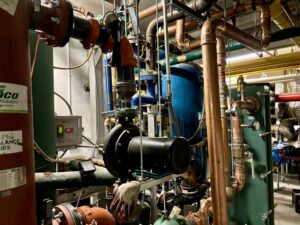
We helped a Manhattan rental building lower its potential LL97 fines by an estimated $94,000 in one year, which translates to 353 tons of CO2 emissions.
At a different building in New York City, we saved 181 tons of CO2 from entering the atmosphere. That is the equivalent of $48K in potential reduced exposure to LL97 fines.
By integrating with a building’s existing HVAC controls, our control optimization software remotely and automatically makes real-time control adjustments based on data from your building and external factors like weather forecasts.
If our service detects an operational anomaly with your equipment, we send color-coded alerts, tiered e-mails, and text messages to building staff as soon as the issue arises. Our service can identify issues in a building before your occupants are impacted.
Plus, we directly reduce CO2 emissions by improving your HVAC systems’ efficiency. We deliver automatic energy savings to reduce your exposure to fines from building performance standards like LL97, BERDO, BEPS, and more.
All 3 of those benefits are a part of our industry-leading Optimizer service.
HVAC optimization software isn’t only a tool—it’s a game-changer for property managers who want to simplify their lives and maximize their building’s potential.
If you’re ready to say goodbye to HVAC headaches and hello to a smarter way of managing your building, we’d love to show you how we can help.
Email contact@paritygo.com or call 1-833-372-7489. You can also visit our website to learn more about how we reduce utility bills in multifamily residential buildings and hotels.
Our HVAC systems were “running wild,” said former board president Dan Donnelly. “In terms of energy, we were performing in the bottom 5% of New York City buildings.”
The building had a D energy grade and faced Local Law 97 (LL97) penalties estimated at $65,000 in 2030.
252 East 57th Street is a 65-story luxury high-rise in Manhattan that is part condo and part rental – each with different HVAC systems.
The rental units use heat pumps, but the condos use four gas-fired boilers for heating and compressors to operate chillers for cooling. Each of the 95 condo units are equipped with four-pipe fan coil units for heating and cooling at any time.
After discovering the poor energy grade and looming LL97 fines, the condo board set up an energy committee led by Dan Donnelly to figure out how to reduce the building’s carbon emissions.
Dan was well-informed about LL97 and building/HVAC efficiency. He was very keen on automation and understood he took the building as far as he could with the existing building staff and Building Management System (BMS) in place.
Gene Kastner, the former Resident Manager at 252 East 57th Street, referred Donnelly to Parity for a high-level and technical overview.
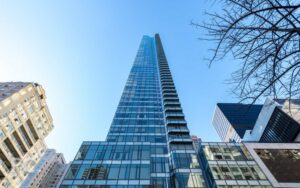
After scoping out the building, we discovered that the largest limitations and problems at 252 East 57th Street came from the HVAC system operations.
We came in with our Optimizer service to fill in the gap and included a large upgrade to their BMS.
Our projected guaranteed savings for 252 East 57th Street was at least $90,000 during the first year.
We over-delivered and saved the building $165,917 in utility costs!
This means that instead of our projected 1.7 year payback, they got their ROI in 8 months.
We also supported Dan’s concern with the LL97 fine. We reduced 252 East 57th Street’s exposure to fines by $60K. That also translates to 226 tons of avoided CO2 in our atmosphere.
We pride ourselves in our ability to decarbonize buildings across NYC by fine-tuning their HVAC systems to run more energy efficiently. And our work here was one of many examples of us doing exactly that.
Let’s take a look at how we were able to reach the $165,917 in savings.
Our savings were largely driven by maximizing evaporative over mechanical cooling. Evaporative cooling, known as free cooling, uses outdoor temperatures via the cooling tower to reject heat from the water in the system, which uses less energy than the compressors to operate a chiller.
“When the system was designed, it was relying a lot more on the chiller,” Kevin Lin, our Director of Systems Integration explains.
The resident manager was then tasked with manually switching to free cooling when outdoor conditions allowed, something that could easily be overlooked. With the new system, the transition to free cooling takes place automatically.
“Last December, we were able to reduce peak demand by 300 to 400 kW, which is significant,” Kevin reported.
Another area of savings came from modifying the building’s make-up air units, which replace air that is ventilated from apartments with exhaust fans.
The condo apartments also have high-end kitchen range hoods that remove a large volume of air. The make-up air units were working at the maximum, even though the range hoods were not in use all day.
“We were able to adjust the airflow so the load met the demand,” Kevin says.
Similarly, the domestic hot water preheating system wasn’t set up to be energy efficient. Water was being preheated 24/7, even during the day when demand was low. We updated this with a combination of variable frequency drives (VFDs) that heated water automatically based on demand and our software.
“A lot of times the pump was just moving water when there was no water on the other side that needed to be preheated,” Kevin says.
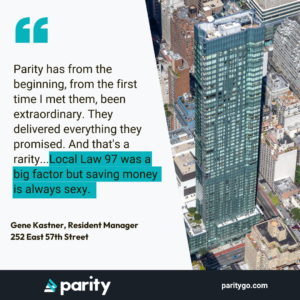
After installation and commissioning are complete, we monitor the building’s HVAC systems to ensure energy efficiency is met and alert the building staff if any issues arise. We do this with Pi (Parity Insights).
Pi keeps Resident Managers like Gene informed about critical HVAC metrics, helps detect and solve anomalies, and provides timely alerts. Our dashboard offers a window directly into how we are optimizing your HVAC systems.
We have a robust alerting system that we fine-tuned to Gene’s exact specifications to warn him of HVAC issues at 252 East 57th Street before resident comfort is affected.
When you partner our control optimization software with our Pi dashboard, you get an advanced energy efficiency solution primed to lower your utility costs, guaranteed.
Are you ready to bring Parity into your building? Email contact@paritygo.com or call 1-833-372-7489 to see if your building is a good fit. You can also visit our website to learn more about how we reduce utility bills in multifamily residential buildings and hotels.
As the chilly winds of winter sweep in, apartment buildings and hotels rely on heating systems to keep residents and guests warm and comfortable.
Boilers and pumps play a pivotal role in the heating process. Optimizing their performance is not only essential for ensuring consistent warmth, but also for maximizing energy efficiency and minimizing energy costs.
In this blog post, we will dive into the world of HVAC heating and shed light on how to maximize the efficiency of boilers and pumps.
Also, check out our previous blog post about staying cool with chillers and cooling towers.
Boilers are the beating heart of many heating systems.
By heating water to produce steam or hot water, boilers maximize the transfer of heat energy to the surrounding space.
Boilers are versatile. Boilers can adapt to various heating applications, whether it’s radiant floor heating, baseboard radiators, or traditional forced-air systems.
With proper maintenance boilers can outlast many other heating systems, providing consistent warmth for years. This durability contributes to a lower environmental impact by reducing the need for frequent replacements.
Regular maintenance and proper insulation are simple ways to make your boiler more efficient.
Ensuring that the boiler is clean, free of debris, and that all components are in good working condition enhances efficiency. Also, proper insulation of the boiler and pipes helps to retain heat and prevent energy loss.
In our opinion, the best way to unlock efficiency for your boiler is by optimizing the controls.
Advanced boiler controls allow for better management of heating cycles, temperature adjustments, and overall system performance. Here are a few examples:
Advanced controls are key to boiler optimization. In addition, features like remote monitoring that provides real-time insights into your boiler’s performance and alerts that enable proactive adjustments and minimize downtime are essential.
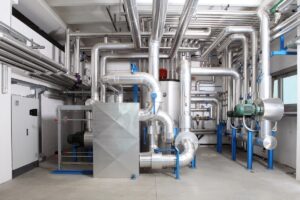
Pumps are the circulatory system of HVAC systems.
While boilers generate the heat, pumps distribute the hot water or steam to various heating elements, such as radiators or underfloor pipes, throughout the building.
The proper selection, sizing, and maintenance of pumps are critical to their overall performance and energy efficiency.
Proper pump sizing and regular pump maintenance are low-hanging fruit efficiency strategies.
Oversized pumps can cause increased energy consumption, while undersized pumps may struggle to meet the heating demand.
Like boilers, pumps require regular maintenance to prevent downtime and extend the pump’s lifespan. This includes checking for leaks, lubricating moving parts, and ensuring that the pump is operating at its specified capacity.
However, like boilers, we believe the key to efficiency lies in optimizing the controls.
Advanced controls can include temperature sensors, pressure adjustments, and automatic speed modulation for improved efficiency. Here are a few examples:
By incorporating these control-focused strategies, pumps can operate at their highest efficiency, resulting in energy savings and reduced energy costs.
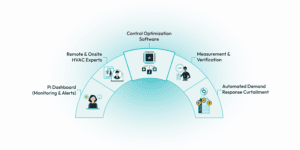
We know running a building is demanding, so we take the daily management of HVAC performance off your shoulders and do the heavy lifting ourselves.
Our control optimization software remotely and automatically adjusts set points, motor speeds, and related performance parameters. This allows the systems to adjust automatically, minimize energy consumption, and reduce your staff’s workload while maintaining a comfortable building climate for your occupants.
Our software can also automate participation in demand response events, further reducing staff workload and securing additional revenue without compromising occupant comfort.
Plus, our Pi (Parity Insights) dashboard offers remote monitoring capabilities for proactive maintenance, early detection of issues, and efficient troubleshooting, minimizing downtime and optimizing pump performance.
As winter’s embrace tightens, the synergy between boilers and pumps becomes increasingly vital for a warm building. Boilers generate the heat, and pumps ensure its efficient delivery, working together to combat the winter chill.
By incorporating efficiency and control optimization strategies, HVAC systems can achieve higher efficiency, lower energy consumption, and reduced environmental impact.
If you want to take your hands off the controls and let Parity micromanage your HVAC systems, email contact@paritygo.com or reach us here.
Zoom. Spotify. Netflix. These are some of the most popular SaaS, or Software as a Service, companies.
But have you ever heard of HVAC Optimization as a Service?
HVAC optimization is the process of enhancing the efficiency, performance, and cost-effectiveness of heating, ventilation, and air conditioning (HVAC) systems.
When you add the “as a Service” piece, you get a subscription-based model where a company regularly manages and improves your HVAC systems performance.
Let’s put it all together.
HVAC Optimization as a Service is an advanced software solution that goes beyond monitoring and analytics to deliver fully automated, real-time control and management of HVAC systems with remote and on-site support.
Optimizing HVAC systems can involve various strategies and technologies that improve how HVAC systems operate daily.
It includes real-time monitoring, automated control adjustments, predictive maintenance, and efficiency improvements, typically using advanced technology and data analytics. This service aims to maximize energy savings, comfort, and system longevity without requiring significant upfront investment from the building owner.
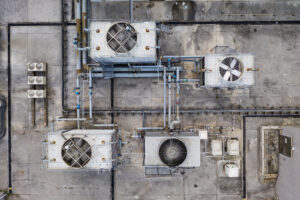
Automated control adjustments are an especially critical component of optimizing HVAC systems. These adjustments combine real-time data, like outdoor weather and occupant demand, with advanced algorithms to create a more efficient and flexible HVAC system.
This means that the HVAC system only uses energy when and where it’s needed, avoiding unnecessary heating or cooling.
Automated control adjustments result in higher energy efficiency, better operational performance, and improved maintenance. Let’s look into this in more detail:
Energy Efficiency: Reducing energy consumption by adjusting performance parameters, upgrading components, or adding more efficient technologies, like variable frequency drives (VFDs).
Performance: Ensuring that HVAC systems operate efficiently and supply meets demand by calibrating controls and adjusting speeds.
Monitoring & Maintenance: Using monitoring systems to detect and resolve issues promptly. Continuous monitoring of system performance helps to track equipment efficiency and effectiveness over time. Learn more about Proactive Maintenance here.
HVAC Optimization as a Service is a new category of energy management primed to disrupt the built environment, and there’s one company leading the way.
At Parity, we know running a building is demanding, so we take the daily management of HVAC performance off your shoulders and do the heavy lifting ourselves.
Our HVAC Optimization approach eliminates the need for constant manual adjustments and allows building managers to achieve maximum energy efficiency while reducing their staff’s workload.
How do we do it? Meet Optimizer.
Optimizer is our HVAC Optimization as a Service solution that micromanages your HVAC systems 24/7/365. It’s designed to lower your utility costs, guaranteed.
Optimizer is made up of our control optimization software, an analytics and monitoring dashboard called Parity Insights (Pi), automated demand response curtailment, and support from our team of remote and onsite HVAC experts.
Our control optimization software is a key piece of Optimizer and our secret sauce. It’s what enables us to save our clients 5 and 6 figures on their utility bills.
Without our software, there would be a crucial missing piece in maximizing the efficiency of HVAC systems and hardware components, like VFDs. Our control optimization software makes these systems “smart”, whether or not you have a BMS.
Here’s how it works:
Our control optimization software actions are autonomously repeated and monitored for variations to guarantee performance. That’s right. We guarantee performance which means if we fall short of our projected energy savings, we cut your building a check for the difference.
Plus, using less energy means lower CO2 emissions, which can help your building lower its exposure to LL97 fines.
When we micromanage your HVAC systems, it frees up building staff’s time, reduces service calls, improves energy efficiency, maximizes demand response revenue, and most importantly, saves your building money.
HVAC Optimization as a Service is an advanced software solution that goes beyond monitoring and analytics to deliver fully automated, real-time control and management of HVAC systems with remote and on-site support.
A key piece of optimizing HVAC systems involves automated control adjustments. Automated control adjustments combine real-time data, like outdoor weather and occupant demand, with advanced algorithms to create a more efficient and flexible HVAC system.
Parity’s Optimizer service eliminates the need for constant manual adjustments and allows building staff to achieve maximum energy efficiency while reducing their workload.
Are you ready to learn more about Parity Optimizer service or how we can help your building, email contact@paritygo.com or call 1-833-372-7489. You can also visit our website to learn more about how we reduce utility bills in multifamily residential buildings and hotels.
BEPS is an acronym for Building Energy Performance Standards. It refers to laws regulating energy use for buildings by local, district, and state governments.
Building Performance Standards (BPS) laws have been passed by various governments across the country. They all vary significantly.
The parts of the DMV with active BEPS laws are the State of Maryland, the District of Columbia, and Montgomery County, MD.
The legislation is changing often as data is gathered on buildings in the region and as our local governments learn what works best from other building performance laws around the country.
These laws aim to achieve a government’s long-term greenhouse gas emission goals by splitting their timeline into smaller compliance cycles.
Compliance cycles were designed to encourage building owners to take action early with small steps toward energy savings, instead of requiring immediate, expensive, and time-consuming overhauls. Each compliance cycle is 5 years long.
To start, multifamily buildings are given an energy use or emissions target to meet based on their size.
If your building meets the target you can relax and forget about BEPS until the next cycle starts in 5 years. If not, you have 5 years to implement changes to reduce energy usage to the target level or face fines.
Then, the next compliance cycle starts with a new, lower building energy target.
DC’s goal is to reduce energy use in buildings by 50% by 2032.
It uses two compliance cycles to achieve this goal. The first compliance cycle began in 2021 and will end in 2026.
DC’s energy target is based on a building’s Energy Star score. Energy Star scores measure a building’s energy use intensity relative to similar buildings in the US, presented as a percentile from 0 to 100.
A building with a score of 100 is in the top 1% of energy efficiency in the country. A score of 1 is very inefficient, while a score of 50 is average.
The target Energy Star score for multifamily buildings in DC is 66. This means that multifamily buildings must be more efficient than 66% of comparable buildings in the US.
The maximum energy use intensity reduction DC’s BEPS law is asking for in each compliance cycle is 20%.
So, if achieving an Energy Star score of 66 would require a greater than 20% energy use reduction in your building, you can instead target the 20% reduction and avoid any fines, even if your Energy Star score is less than the target of 66.
The maximum fine is set at $10 per foot.
The only buildings that would get the maximum fines are buildings that need to reduce their energy use intensity by 20% or more AND make zero progress towards reducing their energy consumption during the compliance cycle.
If your building needs to reduce by 20% but only achieves a 10% reduction, you’d pay $5 per square foot.
If your building only needs to reduce by 10% at the beginning of the cycle to achieve an Energy Star score of 66, the highest fine you could get would be $5 per square foot.
If you got halfway to your target, you’d be fined $2.50 per square foot.
If your building in DC is not meeting its BEPS target, we recommend you implement energy saving measures before the start of 2026. January 1st, 2026 will be the first day of energy use that counts towards compliance.

Montgomery County is using site energy use intensity as the measurement for its BEPS program. This is the amount of energy used per square foot, represented as kBtu/ft2.
The end goal of the county’s BEPS plan is to get multifamily buildings to 37 kBtu/ft2 and is using two compliance cycles to get there.
At the start of the program, multifamily buildings will have their baseline usage set. After 5 years, they will need to meet an interim standard which is halfway to the goal of 37 kBtu/ft2. from where they started. After another 5 years, they will need to be at 37 kBtu/ft2.
A 300,000-square-foot condominium with a site energy use intensity of 57 kBtu/ft2 in 2024 will need to reduce its energy usage to 47 kBtu/ft2 by the end of 2030 and down to 37 kBtu/ft2 by the end of 2035.
For multifamily properties between 25,000 ft2 and 250,000 ft2, the program begins and ends one year later than for properties greater than 250,000 ft2 so enforcement will occur at the end of 2031 and 2036.
The exact fine structure for the Montgomery County BEPS program isn’t clear yet. Current laws limit the fines to $500 for the first offense and $750 for each subsequent offense but whether these fines will be applied annually, daily, or anywhere in between has not been determined.
Maryland’s state-wide BEPS program goal is to incentivize all buildings greater than 35,000 ft2 to achieve net-zero direct greenhouse gas emissions by 2040.
Net direct greenhouse gas emissions are the amount of CO2 being released on-site, typically from the combustion of fuels for space heating, water heating, or cooking, represented as kgCO2/ft2.
Baseline values will be finalized in 2025, then buildings will enter compliance cycles which end in 2030, 2035, and 2040.
Currently, the legislation indicates all multifamily buildings will be held to the same targets. The targets for condominiums will be 0.82 kgCO2/ft2 in 2030, 0.41 kgCO2/ft2 in 2035, and 0 kgCO2/ft2 in 2040.
When fines begin in 2030, Maryland properties not achieving the BEPS standards will be fined annually for each ton of CO2 released by the building beyond the standards. Fine amounts are tied to the EPA’s estimated social cost of carbon dioxide emissions which will be $230/ton of CO2 in 2030.
Maryland also planned on having Site Energy Use Intensity limits, which track both onsite combustibles and electricity usage, but has removed these limits. These are expected to be reinstated in 2027 when they announce new limits that are chosen using the 2025 baselining data to inform the new targets.

You have to follow both.
We recommend taking the time to understand where each law sets the targets for your property.
In most cases, the state law will set more aggressive targets for a given property. The state law also sets a clear structure for its fines. Be sure to keep track of it.
There are currently no BEPS laws or corresponding fines in place for the state or local governments in Virginia.
However, utilities are expensive no matter where you are and many of the improvements related to BEPS can be economically favorable. When done right, energy efficiency measures can lower your community’s operating costs.
If you find that your building’s energy baseline is above the targets for your jurisdiction, there are several options available to achieve compliance.
There is no one-size-fits-all solution to energy performance so it may be worth contacting an energy auditor or advisor in our market to help navigate this process and understand your options.

“Silver Spring” – Image Credit IntangibleArts via Flickr.
Is your building facing BEPS fines? Do you want to learn more about BEPS? Email contact@paritygo.com and we will get back to you soon.