Utility bills that swing month to month. A tenant comfort complaint before your first coffee. Operational budgets with no room for the next surprise repair.
That’s daily life in property management for most multifamily and hospitality teams, and HVAC sits at the center of it. According to the U.S. Department of Energy (DOE), heating and cooling is the single largest energy end-use in U.S. buildings, from apartment towers to commercial properties. That makes it the biggest lever you have on utility costs.
Yet most property management HVAC services still run on the same loop: something breaks, someone calls a contractor, the tenant waits. Repeat.
That cycle keeps equipment running. It doesn’t keep costs down.
Today’s HVAC challenges (volatile energy prices, emissions limits, rising tenant expectations) need more than a standard maintenance contract. They need a strategy for energy efficiency and cost control.
Start with what traditional HVAC services for property managers get right. The core menu is familiar, and every piece of it matters.
Preventive HVAC maintenance. Scheduled inspections, filter changes, coil cleaning, and belt and bearing checks. Regular maintenance extends equipment life, cuts emergency calls, and heads off the breakdowns that trigger complaints. That’s why it lowers long-term costs and lifts tenant satisfaction at the same time.
Emergency repair. 24/7 rapid response when a boiler trips or a pump fails.
Seasonal maintenance. Heating-to-cooling switchovers and start-up checks.
System upgrades. Replacing equipment that has reached the end of its life.
Here’s the gap: like most commercial HVAC maintenance, all of it is periodic. HVAC maintenance for property managers happens on a visit schedule, but your building’s energy use changes by the hour. A technician who tunes the boiler in October can’t adjust it when a warm spell hits in November.
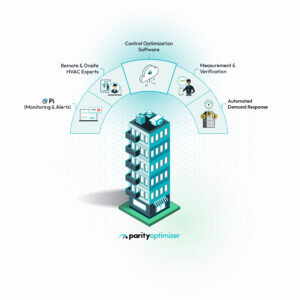
That’s where HVAC optimization comes in. Instead of waiting for the next visit, software reads live system data continuously and makes automated control adjustments remotely. It trims runtime, prevents waste, and holds comfort steady, with no one touching a setpoint.
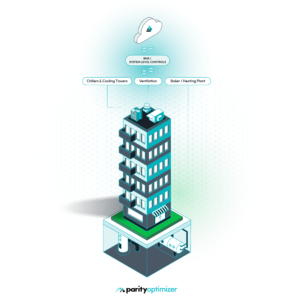
This is the model behind Parity’s Optimizer service: remote HVAC control that works around the clock on the equipment you already have, backed by a team of HVAC experts. It’s energy efficiency as an ongoing process, not an annual visit.
Maintenance keeps your systems healthy. Optimization keeps them efficient. You need both, but only one of them works 24/7.
What do property management HVAC services typically cost for rental properties and apartment complexes? With traditional vendors, the cost structure usually has three layers:
The contract is predictable. The other two layers aren’t. And none of them are tied to what you actually spend on energy.
Parity works differently. Optimizer is designed to cut utility costs by up to 20–30% in multifamily buildings and hotels, and the savings are guaranteed: you get a contracted savings figure, or we cut you a check for the difference. There’s also a no upfront investment option.
That changes the Return on Investment (ROI) conversation with owners and boards. You aren’t asking for capital against a projection. You’re signing up for guaranteed energy savings with a floor under them, which is about as close to a predictable budget as utility cost savings get.
When you compare vendors, ask one plain question: what happens if the savings don’t show up?
A predictable budget starts with someone else carrying the risk.
Curious what your building could save? Get a custom savings estimate.
Emissions limits have turned HVAC from an operating expense into a compliance risk.
In most multifamily buildings and hotels, the HVAC plant (boilers, chillers, pumps, ventilation) is the largest on-site source of greenhouse gas (GHG) emissions. So when a city caps building emissions, it’s effectively capping how your HVAC runs.
Local Law 97 (LL97) in New York City is the best-known example. Covered buildings that exceed their emissions limits face fines of $268 per metric ton of CO2 equivalent over the cap, and the limits tighten sharply in 2030. Boston’s Building Emissions Reduction and Disclosure Ordinance (BERDO) and the Building Energy Performance Standards (BEPS) in Washington, D.C. and Maryland follow the same logic.
Regulatory compliance usually gets framed as a capital problem: replace the boiler, electrify, retrofit. Those projects have their place. But some of the fastest, lowest-cost emissions cuts come from running existing equipment better, burning less fuel for the same comfort.
That’s how Optimizer helps buildings avoid fines. Every hour of wasted runtime it removes is GHG emissions that never reach your compliance report. And Parity’s team knows the building performance standards in every market it serves, so compliance planning comes with the service rather than as a separate consultant.
Want to see where your building stands? Estimate your exposure with our LL97 fine calculator.
Compliance isn’t only about what you install. It’s about how you run what you already have.
The most common worry about any new building technology is disruption. Here, there’s very little. Parity’s Optimizer service works with the HVAC equipment already in your mechanical rooms: no retrofits, nothing installed inside units.
Behind the software sits a team of remote HVAC experts. When Pi flags an issue, on-site staff get a text or email alert. If a problem can’t be solved remotely, Parity’s team works alongside your staff to resolve it.
For your on-site team, the biggest change is what disappears: the manual adjustments, the guesswork setpoint changes, the chasing. Remote optimization takes that work off their shoulders so they can focus on the repairs and resident issues that need a person.
Your staff stop tuning the building and start running it.
Tenants rarely notice when HVAC works. They always notice when it doesn’t.
A freezing lobby while the upper floors bake. Heat that arrives late on the first cold morning of the season. A no-heat call at 2 a.m. Each one lands on your desk, and enough of them show up in renewal decisions and online reviews.
Optimization protects tenant satisfaction in three ways:
Stable climate control. Because the system adjusts continuously, it smooths out the temperature swings that come from static schedules and manual setpoints. Occupant comfort becomes a limit the system protects, not a casualty of cost-cutting.
Fewer failures. Continuous monitoring catches drift and anomalies early, so a failing pump or valve gets fixed before residents feel it.
Faster answers. When a comfort call does come in, your team can see what the system was doing instead of guessing.
That makes HVAC performance a quiet driver of tenant retention. Every renewal you keep is a turnover cost you avoid, and a well-run building protects both its reputation and its long-term property value. For hotels, the same logic applies to guest comfort and reviews.
Saving energy and keeping residents comfortable aren’t competing goals. Done right, they’re the same project.
Most property management HVAC services cost money. This one can make some.
What is demand response? Demand Response (DR) programs pay buildings to temporarily reduce electricity use when the utility grid is under stress, usually on the hottest summer afternoons when air conditioning demand peaks. Grid operators would rather pay you to curtail load than fire up expensive backup power plants.
The catch is execution. Manual DR means someone on staff watching for event notices, running a curtailment protocol on short notice, and hoping residents don’t feel it. Miss an event or underperform, and the revenue shrinks.
Automated demand response removes that work. Parity’s platform automates curtailment during DR events, using a detailed understanding of your HVAC systems to reduce load with precision and without compromising resident comfort. No protocols for staff to run, no events missed, and no one on call waiting for a grid alert on a July afternoon.
At one 288-unit Manhattan rental, automated DR added an estimated $8,000 in revenue on top of the building’s energy savings.
It’s a small shift with a big implication: your HVAC stops being a pure cost center and becomes an asset the grid will pay for.
Managing one building’s HVAC is hard. Managing ten, each with its own contractor, equipment, and reporting format, is a different job entirely.
Multi-building teams feel this most: no consistent view of performance, no easy way to compare buildings, and a stack of vendor relationships to manage. Our guide to multi-site HVAC management covers this in depth, but the short version is centralization.
A centralized view. Optimizer gives you one view of HVAC performance across your property portfolio, so you can see which buildings are on track and which need attention.
Standardized reporting. The same savings and performance metrics for every building, ready for owners, boards, and sustainability reporting.
Consistent performance. One optimization approach applied across your multifamily HVAC systems, from apartment complex HVAC plants with central boilers to hotels.
Simplified vendor management. One accountable partner for optimization, supporting your in-house staff and existing contractors rather than replacing them.
That last point matters when you evaluate any HVAC partner. Look for a provider that offers reliable service, works with your existing systems, reports transparently, knows your local regulations, and puts people behind the software. Then ask each vendor what they’re on the hook for.
A service provider answers calls. A partner answers for results.
Any vendor can promise savings. The real question is how they prove them.
Measurement and verification. Parity uses the International Performance Measurement and Verification Protocol (IPMVP), a widely recognized standard for measuring energy savings, to verify what Optimizer delivers. Savings are measured against your building’s own baseline, not estimated from a brochure.
Transparent reporting. Regular reports detail delivered energy and cost savings, CO2 reductions, and operational improvements. Owners and boards get numbers they can check, not a vendor’s word. In Pi, you can track savings as they accrue and export data for sustainability reporting.
The case studies show what that looks like in practice.
A 288-unit Hell’s Kitchen rental. This 24-floor building had extensive monitoring but no advanced controls or automation, which meant constant manual work for its Resident Manager. Parity’s contracted guaranteed savings were $31,573. Actual year-one savings: $145,245. The projected payback of 1.77 years turned into an actual payback of 10 months. The building also cut 353 tons of CO2 and reduced its potential exposure to LL97 fines by $94,854.
A 392-unit rental with water-source heat pumps. This 24-floor rental building saved $67,702 in actual first-year savings, with an actual payback period of one year.
Those are quantifiable results, verified rather than projected. And they point to the number worth asking every vendor for: not what they promise, but what they’ve actually delivered.
Traditional property management HVAC services will always have a place. Equipment breaks, and someone has to fix it.
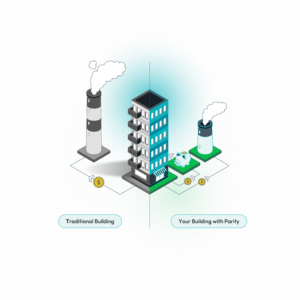
But reactive service alone can’t control utility costs, shield you from emissions fines, or keep tenants comfortable every hour of the year. Smarter HVAC management can.
Parity’s Optimizer runs what’s already in your mechanical rooms 24/7. It’s designed to cut utility costs by up to 20–30%, helps you stay ahead of LL97 and other standards, and can earn Demand Response revenue along the way. There’s a no upfront investment option, and the savings are guaranteed, or we cut you a check for the difference.
That’s more profitable property management and more sustainable operations, built to future-proof your buildings as standards tighten.
Are you ready to save up to 20–30% in utility costs? Get a custom savings estimate and we’ll show you what your building could save before you commit to anything.
Reach us at contact@paritygo.com · 1-833-372-7489 · paritygo.com · See how rental buildings save with Parity.