Your boilers, chillers, and pumps do the work. Your HVAC control system decides how well they do it.
HVAC control systems are the central nervous system of a building’s climate. They regulate temperature, humidity, ventilation, and air quality, and they tell every piece of Heating, Ventilation, and Air Conditioning (HVAC) equipment when to run and how hard.
For a building manager, that means three jobs at once:
Those jobs used to be about comfort alone. Now they sit under rising energy prices and emissions limits like Local Law 97 (LL97).
Controls are where building performance is won or lost.
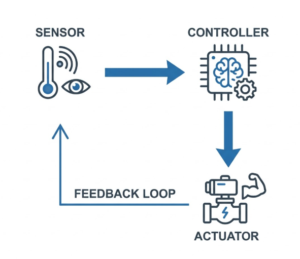
Every HVAC control system, from a single thermostat to a 50-story building platform, runs on the same three parts. The easiest way to picture them is as a body.
Sensors: the eyes and ears. HVAC sensors measure conditions and report them. The most common track temperature, humidity, carbon dioxide (CO2) levels, and pressure in the ducts, the pipes, and the occupied space. Outdoor air sensors add the weather.
Controllers: the brain. Controllers take sensor readings, compare them to a setpoint, and decide what to do. Thermostats are the simplest controllers. In larger buildings, Direct Digital Control (DDC) controllers handle dozens or hundreds of inputs and run programmed logic for each piece of equipment.
Controlled devices: the muscles. Actuators and other controlled devices carry out the controller’s decisions. They open and close valves on hot and chilled water lines, move dampers to let in more or less outside air, and ramp fans and pumps up or down.
These three parts work in a continuous loop. A sensor notices a corridor has dropped two degrees. The controller calls for heat. An actuator opens a valve. The sensor confirms the temperature is recovering, and the controller eases off. That loop runs thousands of times a day.
The weak link is rarely the hardware. It’s the logic in the middle. A sensor that drifts out of calibration, or a setpoint nobody has revisited in five years, quietly steers the whole loop off course.
A control loop is only as smart as the decisions it’s told to make.
Most buildings run a mix of the types of HVAC controls below, one generation layered on another. Knowing which one you have tells you what’s realistically possible.
Pneumatic controls. The original commercial standard used compressed air. Thermostats vary air pressure through small tubes, and that pressure physically moves valves and dampers. Pneumatic controls are simple and durable, and many are still in service in older high-rises. But they drift, they leak, and they can’t report what they’re doing. No data, no remote access, and very little scheduling.
Analog electronic controls. Electrical signals replaced air lines, bringing faster response and better accuracy. The logic was still hard-wired, though, so every adjustment meant someone on site with a screwdriver.
Direct Digital Control (DDC). DDC is the current standard for commercial and multifamily buildings. Microprocessor-based controllers read sensors digitally, run programmable logic, and deliver precise, repeatable control of large equipment. Schedules, resets, and alarms live in software, and a central workstation can see the whole system. DDC is the backbone of most building automation today.
IoT and cloud-based platforms. The latest shift connects controls to the internet. Internet of Things (IoT) devices like smart thermostats and wireless sensors report data continuously. Cloud computing turns that data into something useful: remote access from a phone, analytics across years of history, and machine learning that predicts how a building will behave and adjusts before conditions change.
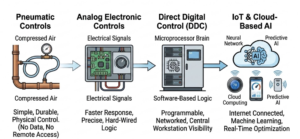
Each generation added the same two things: more information, and more ability to act on it.
The catch is that newer technology doesn’t guarantee better results. A DDC system still running the schedule it was commissioned with in 2008 is doing 2008’s job.
Newer controls raise the ceiling. They don’t raise performance on their own.
When managers compare the types of HVAC control systems, they’re usually looking at three tiers. Each fits a different scale of building, and each sets a different limit on how much control you really have.
In practice, the tiers overlap. Plenty of apartment buildings run DDC on the central plant while residents adjust their own units with in-suite thermostats. Plenty of “BMS” installations are really a DDC system with a dashboard on top.
The question isn’t which tier sounds most advanced. It’s which tier matches the equipment you actually need to control.
DDC vs smart thermostats is one of the most common questions property managers ask. The honest answer: they solve different problems.
Smart thermostats control a room. They’re easy to install and easy to use. Residents and staff get remote control from a phone, schedules are simple to set, and many models learn occupancy patterns. For individual units or small commercial spaces, they’re a clear upgrade over manual thermostats.
DDC controls a building. DDC is built for multi-zone environments like apartment buildings and hotels, where most of the energy use sits in central equipment a wall thermostat never touches. It gives you centralized control and granular settings for each piece: supply water temperature, fan speeds, ventilation rates, equipment staging.
That’s where the big savings live. Strategies like outdoor air reset, optimal start/stop, and coordinated staging only work when one system can see and command the whole plant. A hundred smart thermostats can’t lower your boiler’s supply temperature on a mild day.
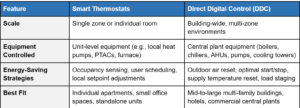
For most properties, the choice comes down to three factors:
In a commercial HVAC setting with central systems, it’s rarely either/or. Smart thermostats improve the unit. DDC improves the building.
A well-installed control system is table stakes. An optimized one is where the payback shows up. Four outcomes matter most.
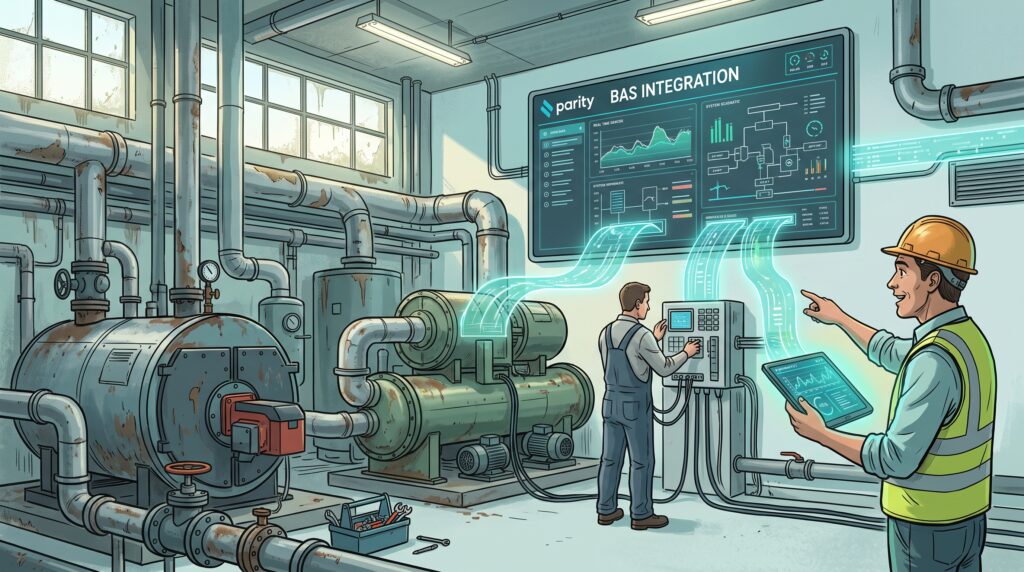
HVAC controls don’t have to work alone. In a fully automated building, they’re one system talking to many.
That conversation runs on communication protocols. The most widely used is BACnet (Building Automation and Control Networks), an open industry standard that lets equipment and software from different manufacturers share data. Modbus is also common, especially at the equipment level. Because these protocols are open, a BAS can pull HVAC, lighting, access control, and metering into one place without locking you into a single manufacturer’s hardware.
Once systems share data, they can act on each other. Picture a hotel. A guest checks in, and the property system tells the BMS the room is now sold. The room’s HVAC moves from an energy-saving setback to a comfortable setpoint before the guest reaches the elevator. At checkout, it drifts back to setback automatically.
In a multifamily building, the same logic applies to amenity spaces. A gym or party room conditions itself when motion sensors or badge swipes show someone is there, and stops when they leave.
That’s what makes an intelligent building: centralized control built on shared data, not a collection of systems each doing its own thing.
Integration has limits, though. A BAS connects systems and executes the rules it’s given. It doesn’t ask whether those rules are still the right ones.
Automation follows instructions. Someone still has to write better ones.
Before upgrading HVAC controls, get clear on four things. They’ll shape every quote you receive.
Building size and complexity. A 500-unit high-rise with a central plant needs different controls than a 20-unit walk-up. Match the system to the equipment and zones you actually have.
Existing infrastructure. Is your current system pneumatic, analog, or DDC? Pneumatic buildings often need new controllers and actuators. DDC buildings may need little or no new hardware, just better use of what’s there.
Budget and ROI goals. Decide what level of savings justifies the spend and how fast you need payback. Then check whether the Return on Investment (ROI) assumes the system stays tuned after installation. Most projections quietly do.
Future needs. Think five to ten years out. Look for scalability and system integration: open protocols like BACnet, room to add sensors, and readiness for programs like demand response and tighter emissions limits.
When you talk to a controls contractor or HVAC installer, ask one plain question: who keeps this system performing after you leave?
Installation is a project. Performance is ongoing.
Automation runs your building by the rules. Optimization keeps rewriting the rules.
Real-time HVAC optimization combines outside data, like weather forecasts, energy prices, and grid signals, with AI and machine learning to adjust your systems before conditions change. It eases off ahead of a mild afternoon, shifts load before a price spike, and automates demand response curtailment when the grid calls for it.
That’s what Parity’s Optimizer service does. It works through your existing BMS — no retrofits, nothing inside units — backed by our remote HVAC experts.
At Avalon Clinton South, a 288-unit Manhattan rental with disparate controls and heavy manual work, Optimizer delivered $145,245 in actual first-year savings against $31,573 guaranteed, with a 10-month actual payback. For more on grid events, read our white paper on how multifamily buildings and hotels can beat the heat.
Optimizer is designed to deliver guaranteed savings of up to 20–30% in utility costs. If we don’t deliver, we cut you a check for the difference.
Ready to see how real-time optimization can cut your building’s utility costs? Learn more about the Optimizer service or book a free energy savings assessment.
Contact us: contact@paritygo.com · 1-833-372-7489 · paritygo.com