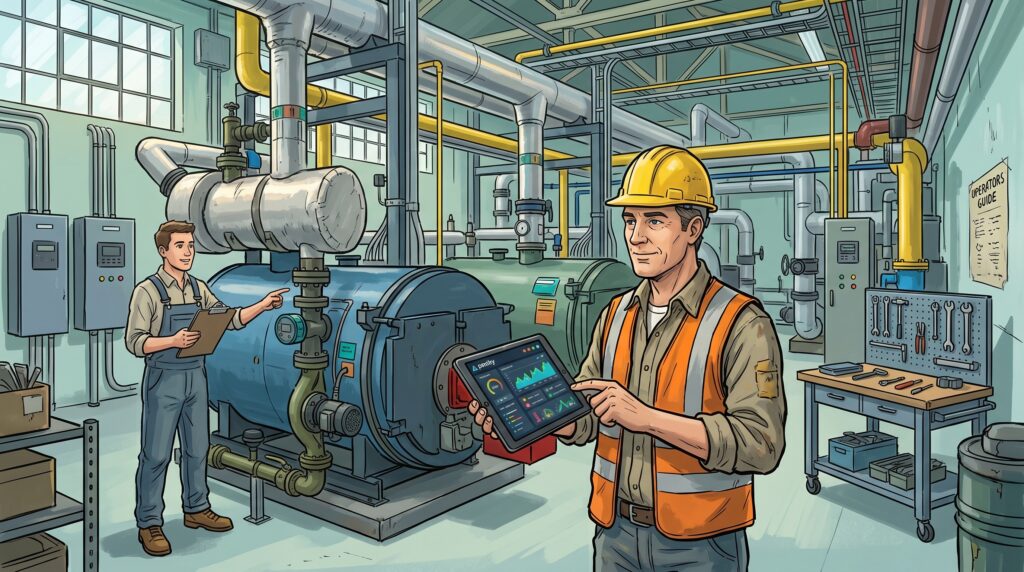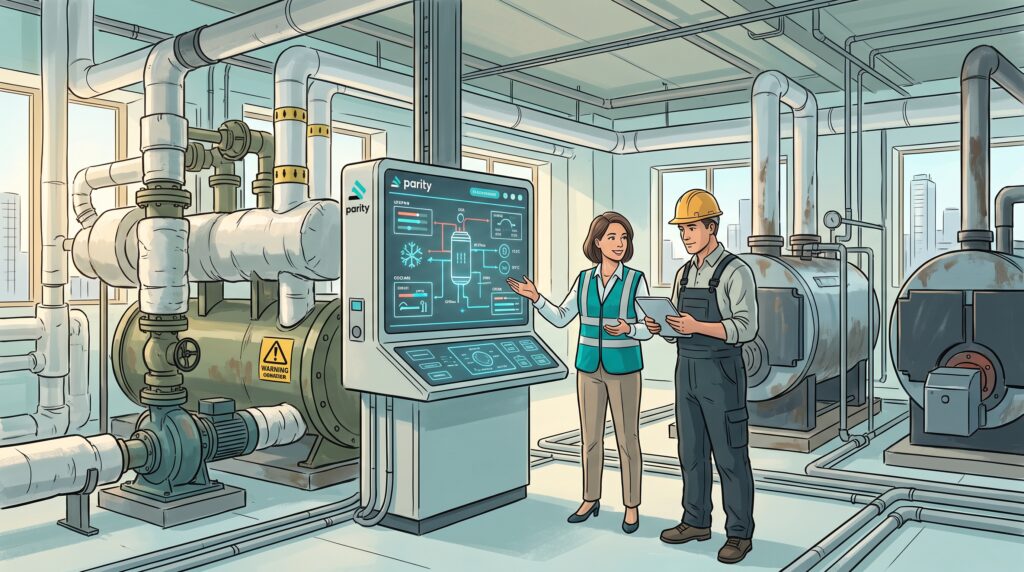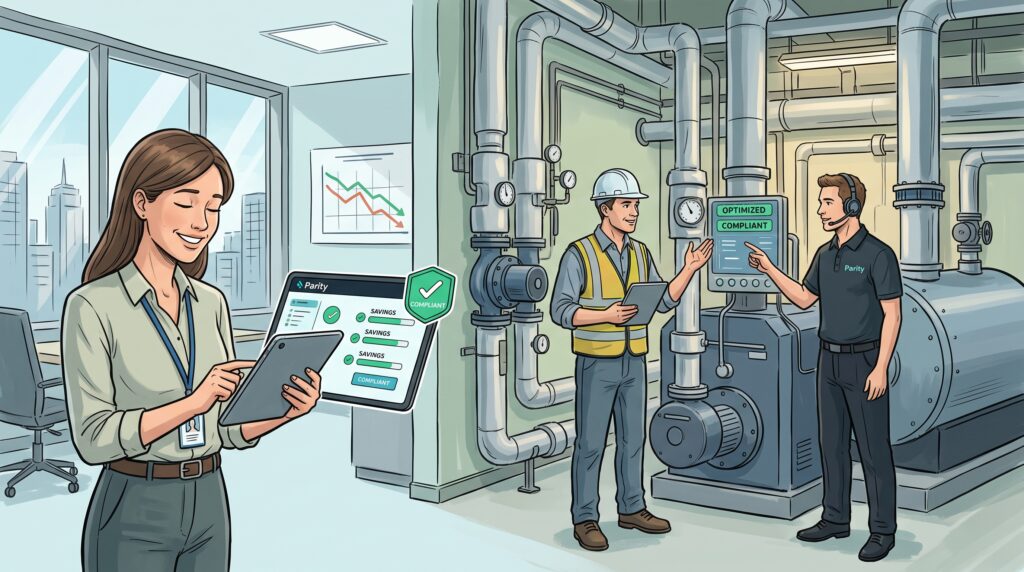
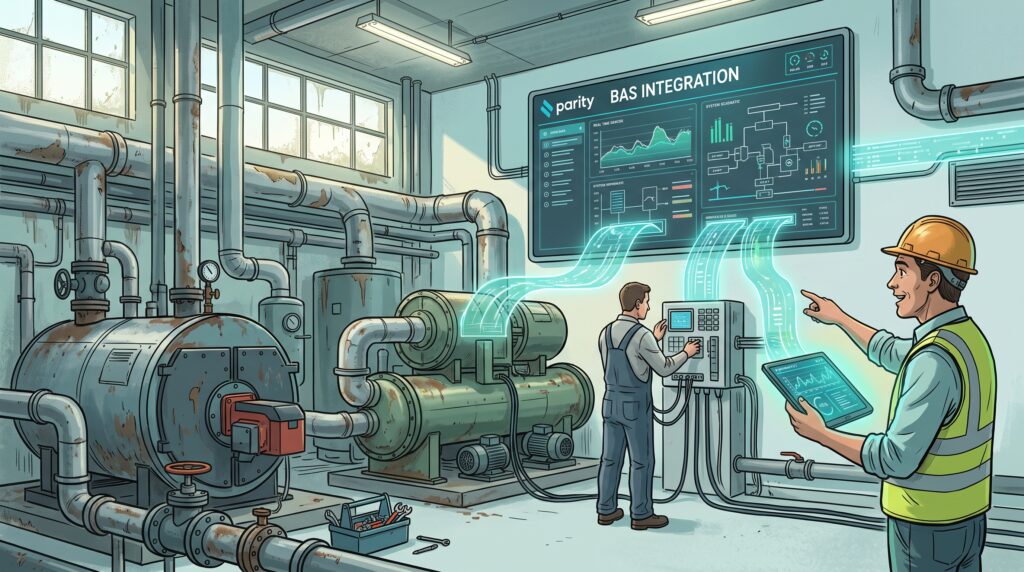
Is your building running itself, or is your team running around it?
An HVAC building automation system is how modern properties answer that question. A Building Automation System (BAS) is a network of hardware and software that monitors and controls a building’s core systems: lighting, security, access, and most critically, HVAC.
Think of it as the building’s central nervous system. It senses conditions, makes decisions, and sends commands, all from one place.
You’ll also hear it called a Building Management System (BMS) or building controls. The names overlap; the job is the same.
That matters more every year. Energy costs keep climbing and swinging. According to the U.S. Energy Information Administration (EIA), space heating alone accounted for nearly a third of commercial building energy use in 2018, with ventilation adding roughly another 10%.
Regulation is tightening too. New York City’s Local Law 97 (LL97) caps building emissions and fines owners $268 for every metric ton of carbon dioxide equivalent over the limit, and the limits drop again in 2030.
Meanwhile, residents and guests expect comfort on every floor, every hour.
Juggling all three by hand doesn’t scale. Building operations that run on manual adjustments and complaint-driven fixes leak money, emissions, and staff time.
That’s why building automation HVAC integration isn’t a luxury anymore. It’s the baseline for an efficient, cost-effective, compliant building.
You can’t manage what you can’t see, and you can’t control what you can’t reach.
The value of integration shows up in four places.
Paired with active optimization, the utility savings get significant. In multifamily buildings and hotels, that can mean up to 20–30% off energy costs, and some providers guarantee it.
That early warning is the foundation of predictive maintenance: servicing equipment based on what the data shows, not what the calendar assumes. Your staff stops chasing problems and starts preventing them.
These benefits compound. Shorter runtimes mean less wear. Less wear means fewer repairs. Fewer repairs free up staff for work that actually improves the building.
Cost, comfort, and compliance usually compete for the same budget. Integration is how they stop competing.
How does a BAS integrate with HVAC systems? Sensors measure conditions, controllers decide what to do, and actuators carry out the decision. All of it runs on a shared communication protocol that lets the BAS see and command every piece of equipment from one interface.
The goal of BAS integration is simple: turn a collection of separate machines into one coordinated HVAC control system. Here’s each layer in plain terms.
Sensors are the senses. They measure temperature, humidity, CO2, occupancy, pressure, and flow, and report it continuously.
Controllers are the brain. Direct Digital Controllers (DDC) and Programmable Logic Controllers (PLCs) take sensor readings, compare them against setpoints and schedules, and decide what each piece of equipment should do next.
Actuators are the muscles. Valves, dampers, and motor drives physically carry out the commands: opening a hot water valve, closing an outside air damper, slowing a fan.
Then there’s the part most guides skip: the language.
Communication protocols are how these components talk to each other and to the central BAS. Three dominate:
Interoperability is where integrations succeed or stall. A chiller that speaks Modbus, a BAS built around BACnet, and a 20-year-old boiler controller can all work together, but only with the right gateways and a clear map of every data point.
That map, called a points list, is worth insisting on. It documents every sensor reading and command the BAS can see, and it’s the first thing any future integrator will ask for.
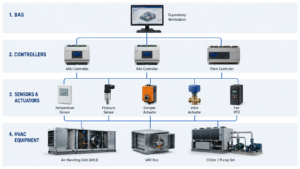
Image Source: Turn2Engineering
The hardware gets the attention. The protocols decide whether it actually works together.
Which BAS platforms lead the market? Most major HVAC manufacturers and independent controls companies offer one. The strongest share a few traits: open protocol support (BACnet first), secure remote access, and integrations with third-party software.
The brand matters less than the fit. A platform built for a hospital campus may be overkill for a 200-unit rental, and a basic energy management system may be too thin for a full-service hotel. When comparing BAS vendors, weigh these factors.
Scalability. Can it grow with you, adding points, equipment, or buildings, without a platform change?
Interoperability. Does it work with the equipment you already have? Adding HVAC building automation should rarely require an HVAC system replacement. Ask for a points-list review before you sign.
User interface. Is it intuitive for your team? A BAS your super won’t open is an expensive thermostat.
Cloud-based vs. on-premise. On-premise systems keep data and control inside the building. A cloud-based BAS adds remote access from anywhere, off-site data storage, easier software updates, and portfolio-wide views. For most multifamily and hospitality teams, cloud flexibility wins, provided it’s secured properly.
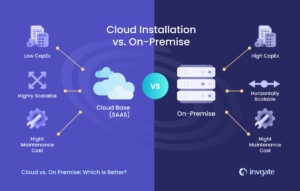
Image Source: Invgate
Total cost of ownership (TCO). Look past the sticker price. Licensing, service contracts, programming changes, training, and future expansion often outweigh the initial install.
Then ask each vendor one plain question: once it’s installed, who makes sure it keeps saving energy?
The cheapest BAS to buy is rarely the cheapest to own.
Here’s the uncomfortable truth about building automation: a BAS is a platform, not a strategy.
It does exactly what it’s programmed to do. Setpoints, schedules, and sequences usually get set at commissioning, then sit there while weather, occupancy, energy prices, and equipment condition change around them. Performance drifts. Savings quietly erode.
The BAS isn’t the problem. The intelligence driving it is.
That’s the gap Parity’s Optimizer Service fills. Optimizer is a specialized intelligence layer that works alongside your existing BAS. Where a building needs it, the project scope can include the control panel, VFDs, or BMS required to connect.
It goes well beyond monitoring. Our control optimization software makes real-time optimization decisions and pushes automated control adjustments to your central equipment (chillers, boilers, pumps, domestic hot water, and ventilation) 24/7.
No retrofits. Nothing installed inside units. No rip-and-replace.
Parity’s team of HVAC experts works alongside your on-site staff, not around them. Building staff also get Pi (Parity Insights), a monitoring and alerts dashboard that acts as an extra set of eyes on equipment, even when nobody’s at the building.
Then there’s the part that changes the financial conversation: Guaranteed Energy Savings. Parity contractually guarantees your savings. If they fall short, we cut you a check for the difference. And with a no upfront investment option, the risk that stalls most efficiency projects comes off your balance sheet.
The same control unlocks new revenue through automated demand response. At The Oxford, a 44-story Upper East Side condo, Parity automates ventilation units and exhaust fans during grid events. Common area energy use dropped around 44% across three July events, with an estimated reward in the region of $10,000.
A monitoring tool tells you what went wrong. An optimization partner is on the hook for the result.
Every BAS project eventually lands on an owner’s or board’s desk with one question: does it pay for itself?
Here’s a framework for a defensible ROI calculation and business case.
Step 1: Tally the upfront investment. Hardware, software, installation, programming, integration gateways, and commissioning.
Step 2: Add ongoing costs. Licensing, service contracts, and maintenance.
Step 3: Project total annual savings. This is where most cost analysis undercounts. Savings come from four places:
Step 4: Run the numbers.
Simple payback (years) ≈ upfront investment ÷ (annual savings − annual ongoing costs)
A hypothetical example. A 250-unit multifamily building spends $400,000 a year on HVAC energy. A BAS upgrade costs $180,000 installed, plus $12,000 a year in service. At 15% savings, that’s $60,000 a year, or $48,000 net: a payback period of about 3.75 years.
The weak point is Step 3. Every figure is a projection. If savings land at 8% instead of 15%, that payback stretches to nine years.
A guaranteed-savings model turns the most uncertain variable into a contractual floor. At 1020 Grand Concourse, a 23-floor, 453-unit Bronx co-op, Parity contracted $44,934 in guaranteed savings and delivered $67,603 in actual year-one savings. The projected 1.3-year payback arrived in 12 months, with $44,607 in potential reduced LL97 fine exposure.
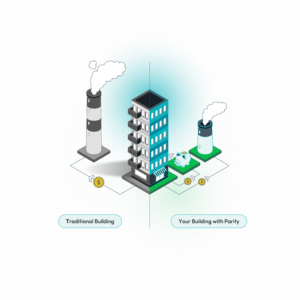
Factoring LL97 into your numbers? Download our LL97 compliance guide.
A projection is a hope. A guarantee is a number you can budget around.
The BAS of ten years ago followed rules. The next generation learns.
The Internet of Things (IoT) makes data granular. Wireless sensors are affordable and quick to install, so a building can measure conditions zone by zone instead of only at the air handler, without running new wiring through occupied spaces.
Artificial Intelligence (AI) and Machine Learning (ML) turn that data into foresight. ML models learn how your building actually behaves: how fast the north side loses heat, when occupancy peaks, how the boiler plant responds to a cold snap.
That shifts control from reactive adjustments to predictive optimization. The system pre-heats ahead of a cold front, shifts load before a price spike, and eases ventilation as spaces empty.
Advanced analytics close the loop, tracking every adjustment against a baseline so savings are measured rather than assumed. That same data feeds sustainability reporting and building performance standard filings, so compliance stops being a once-a-year scramble.
The technology also changes what staff see. Instead of hundreds of raw alarms, a well-tuned smart building HVAC setup surfaces the few issues that matter, ranked by impact, with a likely cause attached.
None of this is distant future tech. It’s what a smart building runs on today, and it’s what services like Parity’s Optimizer already use to drive results in multifamily buildings and hotels.
The future-proof building isn’t the one with the newest hardware. It’s the one that keeps getting smarter about the hardware it has.
Connecting building systems to a network opens a door. Your job is to control who walks through it.
A compromised BAS can expose building data, disrupt comfort, or become an entry point into the wider business network. Many older controllers were designed before network security was a concern, and some still run on default passwords set at the factory.
BAS cybersecurity comes down to a few disciplined habits:
Strong network security also means asking hard questions. Ask any partner how your data is transmitted and stored, and who can reach your controls.
System integrity isn’t only about hackers, though. Sensors drift out of calibration. Overrides get left in place. Sequences get “temporarily” changed and never restored.
Ongoing maintenance and periodic commissioning, re-testing that the system still operates as designed, keep a BAS delivering what it promised. Build a simple routine: calibrate critical sensors annually, review active overrides monthly, and re-commission after any major equipment change.
A BAS rarely fails all at once. It fails one forgotten override at a time.
Integrating your HVAC with a BAS is the foundational step toward a smarter, more efficient building: centralized control, real-time visibility, and the data you need for cost reduction and your sustainability goals.
It turns a patchwork of equipment into one coordinated system your team can see and steer.
But the platform is only half the story. A BAS gives you the controls. Intelligent automation decides how well they’re used, every hour, as conditions change.
That’s where Parity comes in. Our Optimizer Service adds guaranteed HVAC optimization to what’s already in your mechanical rooms, with no retrofits, nothing inside units, and a no upfront investment option.
On buildings like yours, we typically pull up to 20–30% out of energy costs — guaranteed, or we cut you a check for the difference.
Are you ready to save up to 20–30% in utility costs? Request a free savings analysis and we’ll show you a customized projection for your property before you commit to anything.
Contact us: contact@paritygo.com · 1-833-372-7489 · paritygo.com · Explore the Optimizer service · See how demand response adds revenue · Read on building performance standards.