The Cost Of Staying Comfortable
Energy is now one of the fastest-growing line items on a hotel’s P&L and it’s not alone.
Labor, renovation cycles, and technology upgrades are all climbing at the same time, squeezing margins from every direction.
Hotels can’t control all of it,but energy is one of the few costs that can be addressed.
Hotels can’t avoid rising costs across the board, but energy is one of the most direct levers available to offset them, well before turning to blunter tools like raising room rates.
Where Hotel Energy Is Hard To Control
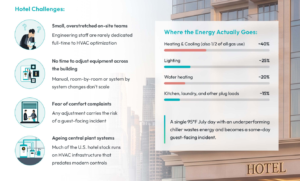
Hotel’s HVAC systems almost never gets to rest.
Unlike an office or retail space that powers down overnight, a hotel runs 24 hours a day, 365 days a year, heating, cooling, and circulating air continuously to keep guests comfortable at every hour, even when guests aren’t in their rooms every hour.
This makes HVAC systems one of many energy consuming activities in a hotel that make it challenging to control the building with manual management alone.

How Automation Reduces Hotel Energy Costs
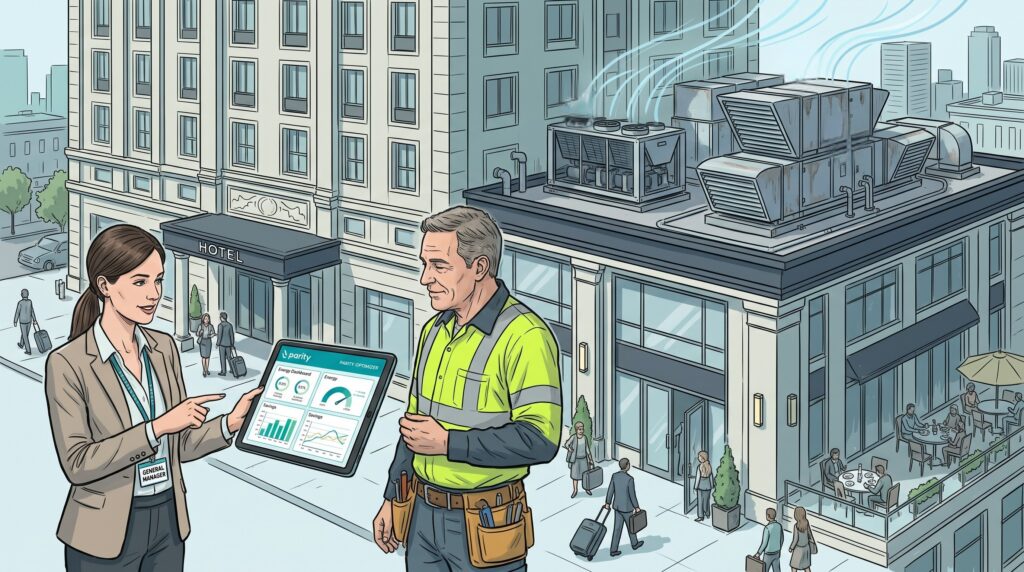
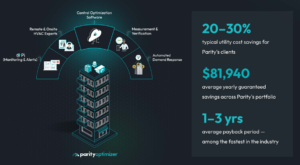
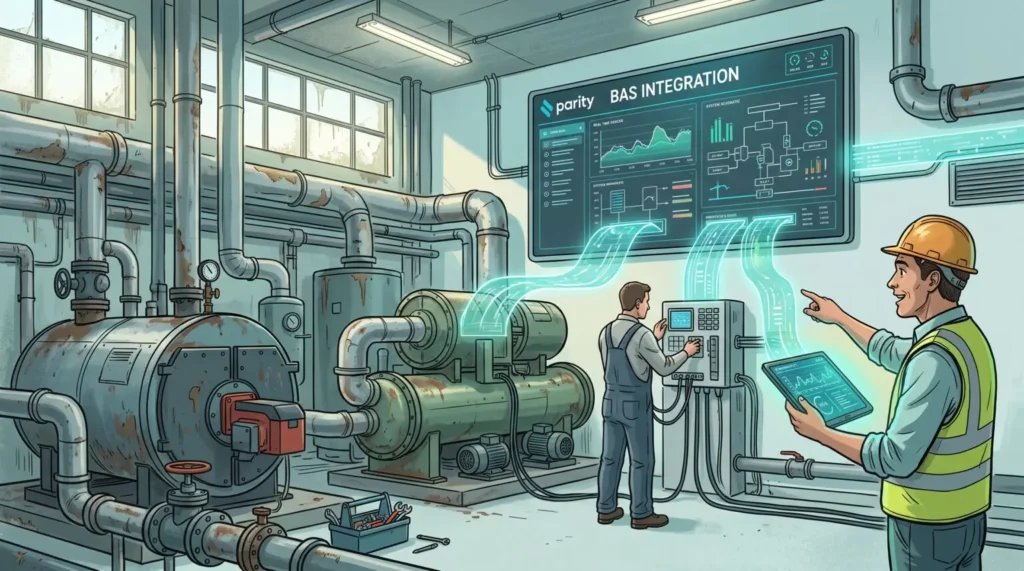
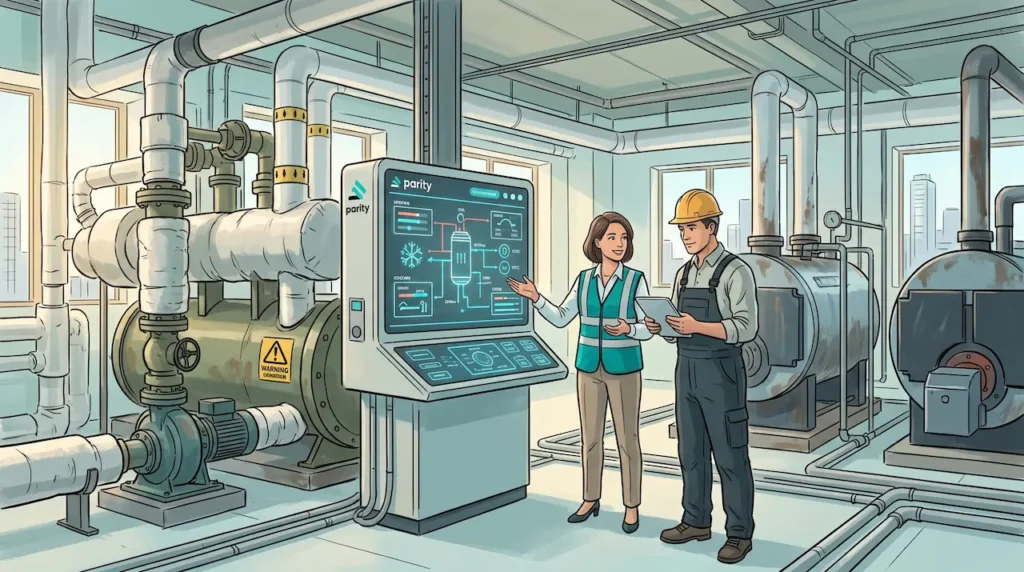
Parity’s Optimizer service plugs directly into a hotel’s existing BMS and/or HVAC controls, providing automation with zero upfront investment. No rip-and-replace, no CapEx fight, no downtime.
This quick path to automation allows hotels to:
- Optimize continuously – Real-time, automated control adjustments to pumps, ventilation, domestic hot water, chillers, boilers, and cooling towers based on building data and weather forecasts.
- Catch problems early – 24/7 remote monitoring and alerting flags anomalies (like a stuckvalve or VFD fault) before they become guest-facing issues,and before the inefficiency becomes costly.
- Participate in demand response – Automated curtailment during grid events earns additional revenue without touching guest comfort.
- Report & guarantee – Regular savings reporting against a contractual guarantee; Parity cuts a check for any shortfall.
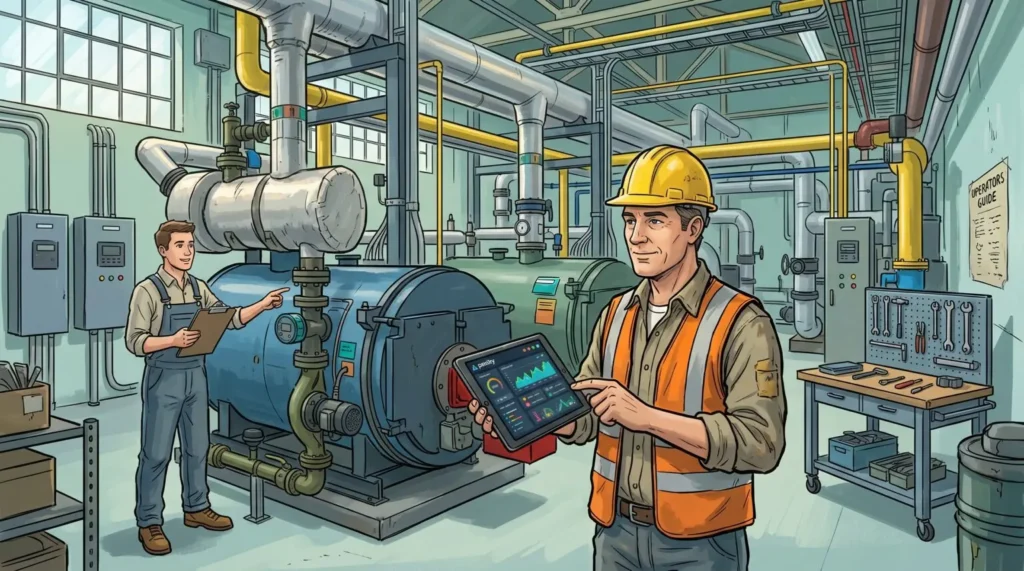
- Free up on-site teams – With HVAC automated, less time is spent from maintenance and engineering staff,so on-site teams can focus on the issues guests actually notice – from leaks and broken locks to malfunctioning vending machines.
Local Law 97: Understanding It’s Impact
- New York’s Local Law 97 gives hotels their own emissions cap, and makes the cost of inefficiency explicit and recurring.
- Hotels are capped at 0.00987 tCO2e per square foot during the 2024-2029 compliance period (occupancy group R-1). This is tighter than the multifamily cap (0.00675, group R-2).
- LL97 fines run $268 per metric ton of CO2e a building emits above its cap, charged every year the building remains over.
- Enforcement is active: annual emissions reporting began in 2025, with penalties applying at scale in 2026 and limits tightening again in 2030.
- Citywide, across all Local Law 97-covered building types, about 91% of buildings meet their 2024 cap, but only about 43% are on track to meet the far stricter 2030 cap.
- This isn’t only a New York story: Los Angeles (EBEWE), Seattle (BEPS), Boston (BERDO 2.0), and Washington, D.C. (BEPS) all run their own benchmarking and building-performance-standard programs for hotels and other large buildings.
Building Performance Standards Are Being Formed Across The U.S.
Boston gives hotels their own emissions limit, and puts a per-ton price on every year a building runs over it.
- Hotels (BERDO’s Lodging use) are limited to 5.8 kgCO2e per square foot (0.0058 tCO2e) during 2025-2029, dropping to 3.7 in 2030. The multifamily limit is 4.1 kgCO2e.
- Buildings over their limit can make Alternative Compliance Payments of $234 per metric ton of CO2e above the limit, paid every year they remain over. Buildings that don’t comply face fines of up to $1,000 per day.
- Enforcement is active: emissions limits took effect in 2025 for buildings of 35,000+ sq ft. First compliance results were determined in 2026, and limits tighten again in 2030 on a path to net zero by 2050.
- Of roughly 1,070 buildings, campuses and portfolios subject to 2025 limits, the City has so far confirmed 766 in compliance and 44 needing action. The 2030 hotel limit is 36% lower.
Montgomery County’s BEPS gives hotels their own energy-use target, and makes missing it a recurring civil violation.
- Hotels must reach a final site energy use intensity (EUI) of 60 kBtu per square foot. The interim target sits halfway between each building’s baseline and that final standard. The multifamily final standard is 37 kBtu/sf.
- Missing a target, or failing to file an improvement plan, is a Class A civil violation: $500 for the first citation and $750 for repeats, with each day counted as a separate offense. State law now allows the County to raise fines further.
- Hotels of 50,000+ sq ft are judged on 2028 energy use for the interim standard and 2033 for the final. Hotels of 25,000-50,000 sq ft are judged on 2030 and 2035. Results are reported each June 1.
- Based on 2023 benchmarking data, about one-third of all covered buildings already meet their final standard. The other two-thirds must cut energy use or file a retrofit plan.
Washington, D.C.’s BEPS gives hotels their own energy performance standard, and charges buildings that fall short by the square foot.
- Hotels must reach an ENERGY STAR score of 54 in the first cycle, which is the local median for D.C. hotels. Multifamily buildings must reach 66, the local median for their property type.
- Buildings that miss the requirements of their compliance pathway face alternative compliance payments of up to $10 per gross square foot, capped at $7.5 million per building.
- Enforcement is here: the first compliance cycle ends December 31, 2026, and final reports are due in May 2027. The next cycle begins January 1, 2029 and expands coverage to buildings of 25,000+ sq ft.
- Among hotels that had to take action, 69% on the Standard Target pathway met the threshold on 2024 data. On the Performance pathway, 41% had reached the required 20% energy reduction.
Parity’s Hotel Clients Savings
The Hyatt Centric Wall Street, a 42 story property hosting 253 hotel rooms and 346 condo units, was guaranteed $76,487 in contracted guaranteed savings.
The building saw $124,794 in actual savings, 63% above the amount they were guaranteed and hitting payback in 1.9 years.
Curtailing their energy use through their HVAC systems also helped the property cut their CO2 emissions by 138 tons, eliminating $37,074 in potential LL97 fine exposure.
The Langham, a 60 story property with 234 hotel rooms and 163 condo units, saw similar substantial savings. The building was contractually guaranteed $90,076. Parity overdelivered our savings guarantee by 112%, helping the property achieve $191,352 in actual savings and hitting payback in 1.6 years.
This reduction in energy consumption slashed the hotel’s CO2 emissions by 183, avoiding $49,163 in potential LL97 fine exposure.
These results come from two implementations, not a guaranteed industry average, but they show the range of what’s possible when HVAC optimization is applied to a hotel’s specific operating profile.
What To Do Next
- Audit Your Current Energy HVAC Management Process – Start with a deep-dive review of monthly and annual utility bills to see where costs are rising
- Identify Where You’re Losing Money to Manual Adjustments and Reactive Fixes – Look for patterns of overcorrection, comfort complaints, and equipment run overnight or during unoccupied hours
- Review System Settings – Multiple times a day to ensure comoftr and efficiency or stop doing it manually altogether
- Skip Step 1 – 3: Let Parity automate it
Ready to turn your hotel’s HVAC system from a liability to a guaranteed source of savings? Book a free energy savings assessment, and we’ll show you what your building could save before you commit to anything.
Reach us at contact@paritygo.com · 1-833-372-7489 · paritygo.com