
2025 marked a significant year for real estate.
Across the United States, rampant concerns about rising utility rates, grid instability, and the imposition of building decarbonization fines kept property owners and operators on their toes.
Multifamily and hotel buildings were no exception.
Propmodo predicts a multifamily recession in 2026, and CoStar reported that for the first time since 2020, hotel occupancy and revenue per available room saw a decline in 2025.
Revenues are expected to decline while costs are skyrocketing, leaving bottom lines in the danger zone.
Whether it’s New York or California, a rental or hotel, building staff need to be aware of curveballs headed their way so that they can stay ahead of them.
Runaway utility rates have been the central topic of concern in recent months.
Distress over rising energy costs has grown so substantial that multiple gubernatorial and mayoral races across different states ran on, and won, platforms vowing to fight back against these rising rates.
For example, a Utility Dive article covering the newly elected governor of Virginia, Abigail Spanberger, D, and her administration’s focus on clean energy and energy affordability cites, “Governor-elect Spanberger and fellow Democrats outlined their strategy agenda last month, emphasizing the need to lower costs.”
Across state lines and sectors of real estate, the burden of rising utility rates is hitting everyone hard.
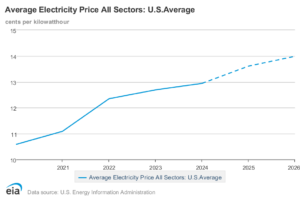
Image Source: The EIA, Average Electricity Price All Sectors: U.S. Average
However, residential real estate seems to be taking the worst hit.
According to the EIA, the national average residential price per kilowatt hour in 2026 is 18 cents, a 37% increase since 2020.
Simply put, properties are spending 37% more on utility costs for the same amount of consumption.
Overall, according to Utilities Dive, “…regardless of how increases compare with overall inflation, residential rates have risen faster than those for commercial and industrial customers, shaping public perceptions about fairness.”
For multifamily buildings and hotels, where HVAC systems represent a significant portion of operational expenses, rising utility rates can severely impact budgets and bottom lines.
Building owners and operators have to seek out intelligent solutions to optimize their energy consumption.
This isn’t about turning down thermostats; it’s about implementing sophisticated systems that learn, adapt, and predict energy needs based on your building.
By reducing unnecessary energy waste, buildings can mitigate the impact of rising utility rates and free up resources for other critical investments.
As our energy infrastructure ages and demand grows, grid instability is becoming a more frequent issue.
Some areas struggle with grid instability more than others. This is especially true for areas where data centers are expected to be built.
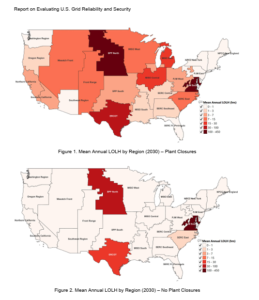
Image Source: GridBeyond, US grid reliability and security at risk, warns DOE
Increasing demand, coupled with data center load requirements, adds an unprecedented amount of weight added to an already strained grid.
Unfortunately, the grid is arguably one of the most inflexible structures. It takes a huge amount of time, planning, and capital to build up to boost its transmission capacity.
This solution could take years and, in that time, have already caused blackouts or failures, leading to disruptions in building operations and disgruntled residents or guests.
The root of the problem is too much necessity, too little capacity.
In 2026, a central focus will be on maximizing the use of existing infrastructure and squeezing out every bit of existing capacity.
Demand response programs incentivize large energy consumers, like multifamily buildings and hotels, to reduce their energy usage during peak demand periods.
Participating in demand response offers a win-win scenario; buildings earn financial incentives for shedding load when the grid is stressed, while simultaneously contributing to grid stability and reliability.
Optimizing HVAC systems allows multifamily buildings and hotels to turn into Grid-Interactive Efficient Buildings (GEBS) that earn revenue from program payouts.
Buildings need HVAC systems that can intelligently adjust energy consumption without compromising occupant comfort.
This proactive approach to energy management will be crucial for both financial gain and operational resilience.
The push for a greener future is intensifying, and with it, a wave of building decarbonization laws is sweeping across regions.
Building decarbonization standards like NYC’s Local Law 97 (LL97), Boston’s Building Energy Reporting and Disclosure Ordinance (BERDO), and the DMV’s Building Energy Performance Standards (BEPS) are setting stringent limits on carbon emissions from existing buildings.
While the focus of these building decarbonization ordinances strives for greater sustainability in residential real estate, they carry significant financial implications that affect properties, including hefty fines for non-compliance.
They necessitate a fundamental rethinking of building operations, particularly HVAC systems.
Older, inefficient HVAC systems are major contributors to carbon emissions.
To comply with building decarbonization regulations and avoid penalties, buildings must invest in modernization and optimization.
Retrofitting building equipment can take years for approval and installation, and requires massive capital expenditure.
Optimizing existing HVAC systems is a quicker solution that promises faster returns and complies with building decarbonization standards in the near term.
Properties can benefit from reduced CO2 emissions from HVAC systems consuming less energy, translating to reduced fines from building performance standards.
However, compliance with local laws is only one part of the story.
The necessity for building decarbonization reaches beyond the need to operate more sustainably; it enhances the operational efficiency of their buildings, improves their market value, and attracts environmentally conscious tenants, guests, and investors.
Managing a multifamily and hotel building is growing increasingly complicated.
Property management has shifted from overseeing operations to actively sourcing the most efficient ways of operating buildings while producing maximum value.
With trends pointing toward declining occupancy rates in both multifamily properties and hotels, getting smart with securing bottom lines against costs and fines is the only way to survive.
The challenges of 2026—rising utility rates, grid instability, and building performance standards—are significant, but so are the opportunities for those who adapt.
With trends pointing toward declining occupancy rates in both multifamily properties and hotels, getting smart with securing bottom lines against costs and fines is the only way to survive.
The challenges of 2026—rising utility rates, grid instability, and building performance standards—are significant, but so are the opportunities for those who adapt.
HVAC optimization as a service provides a comprehensive solution, enabling multifamily buildings and hotels to navigate these threats successfully.
By leveraging advanced analytics, intelligent controls, and expert insights, buildings can:
525 West 52nd Street, a 24-floor luxury rental building in Manhattan, New York, was facing rising utility rates, high energy consumption, and looming LL97 fines.
With the optimization of the building’s water-sourced heat pumps that provided central heating and cooling, the building was projected to save at least $39,848 in guaranteed utility costs in its first year working with Parity.
Performance outdid projections, and we delivered $67,702 in utility cost savings. That’s 1.6x more in achieved savings than was predicted.
No expensive retrofits or proprietary hardware—only existing HVAC systems being optimized.
The optimized HVAC systems prevented 42 tons of CO2 emissions, translating to $11,148 saved from potential LL97 fine exposure.
To top it off, Parity automated demand response curtailment, generating $15,000 in demand response revenue.
All in all, 525 West 52nd was able to contribute over $90,000 toward the property’s bottom line, which would have otherwise been expended on unnecessary costs and fines.
During a time of unprecedented rising energy costs and building decarbonization fines, “every dollar counts,” says Andrew Schwartz, Senior VP of Residential Asset Management at Taconic Partners.
The future of energy efficiency is here, and it’s smart, sustainable, and optimized.
To learn more about how Parity’s HVAC optimization service can help achieve utility cost savings and reduce fines from building performance standards, contact contact@paritygo.com or call 1-833-372-7489.
The energy landscape is evolving. According to a report from PowerLines, utility costs are rising faster than inflation.
In the first half of 2025, U.S. utility companies requested $29 billion in utility rate hikes, affecting over 40 million customers. Residential electricity costs have risen by almost 30% since 2021, and residential gas costs have increased by nearly 40% since 2019, according to the U.S. Energy Information Administration (EIA).
These aren’t short-term adjustments. They signal a lasting shift in how electricity is generated, delivered, and priced, making planning building operations around utility rate hikes essential for controlling long-term costs.
More than ever, building managers need to think like grid operators to stay ahead of rising utility costs. 3 main forces are accelerating the rate of increase across the country:
For buildings with outdated HVAC systems, the pressure is mounting. Old systems were built for a predictable grid, not one strained by extreme heat and surging demand. What was once focused on comfort must now respond to volatility.
As rates rise, failing to plan building operations around utility rate hikes only increases the cost of inaction. Every month a building operates without adjusting to today’s energy landscape, it takes on more financial risk. Peak pricing, capacity charges, and seasonal volatility can quietly add thousands to utility costs.
In regions like New York and California, a single high-demand event can define a building’s peak load for the year, triggering monthly charges long after the moment has passed. Buildings that lack real-time responsiveness or seasonal strategies, the foundation of planning building operations around utility rate hikes, have no way to defend themselves from these costs.
Yet many still operate under outdated assumptions. They treat energy as a fixed overhead, rather than a variable cost shaped by timing and behavior. That mindset worked when the grid was simpler. But today, utilities don’t just charge for how much energy you use. They charge for when and how you use it.
Staying passive in the current energy environment is no longer safe. It’s a financial decision (or lack thereof) that exposes buildings to risk they can’t see until the bill arrives. And those bills are only getting bigger.
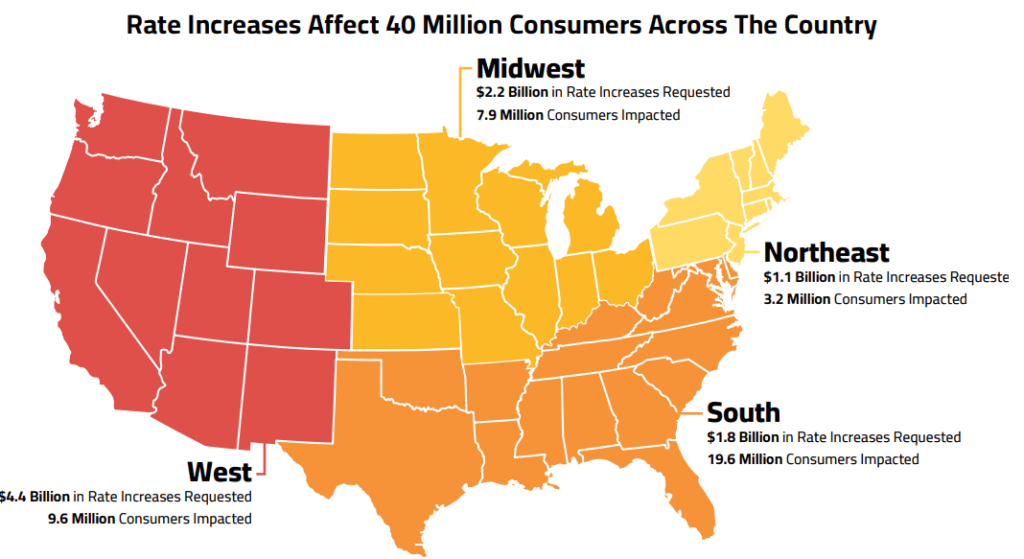
Image credit PowerLines
Grid operators are not passive energy users. They anticipate demand, monitor real-time conditions, and adjust proactively to prevent system strain. Building managers must adopt that same proactive mindset if they want to effectively plan building operations around utility rate hikes.
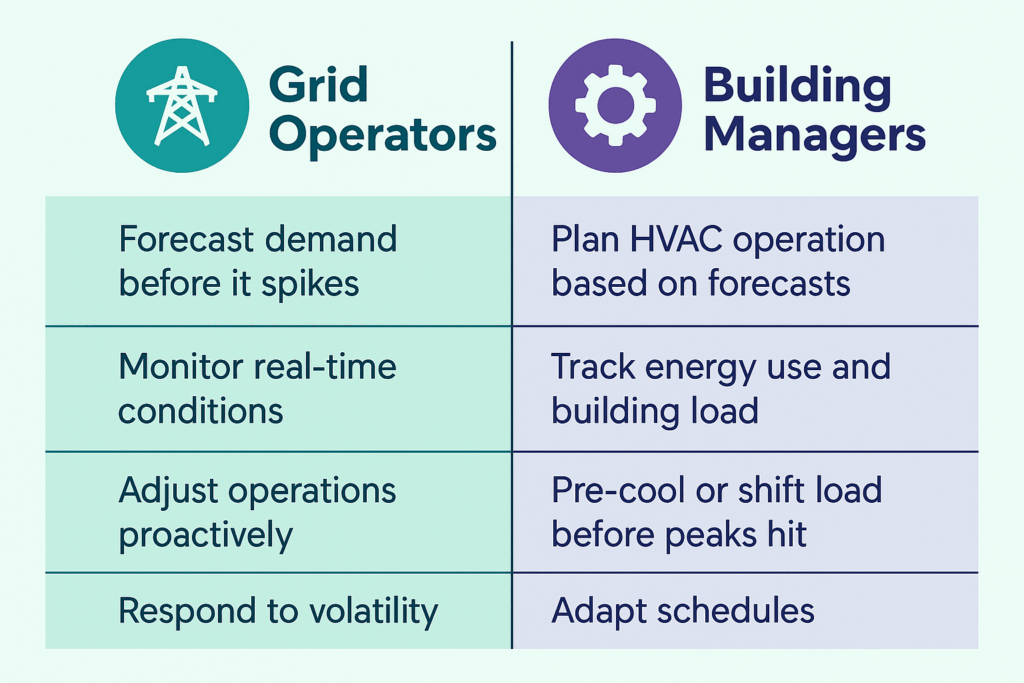
The more volatility the grid experiences, the more that volatility is priced into every kilowatt-hour a building consumes.
Utilities have shifted significant responsibility downstream. Charges based on peak usage, demand intervals, and seasonal load profiles signal that buildings are expected to manage not just consumption, but impact. The rules have changed, and buildings that do not adapt will continue to pay a premium.
This shift calls for a new operating mindset. One where building teams don’t just react to bills but work to understand what’s driving them. That means identifying the building’s peak load moments, anticipating when the grid will be most stressed, and aligning HVAC operation accordingly.
A grid operator would never walk into a heatwave blind. A building shouldn’t either. Especially when planning building operations around utility rate hikes, protecting both budgets and comfort.
Parity helps multifamily buildings and hotels plan operations around utility rate hikes without relying on guesswork, spreadsheets, or reactive strategies. Our service automates demand response protocols to avoid unnecessary peak demand charges, reduce exposure to capacity charges, and smooth out volatility in energy spend, without sacrificing tenant comfort.
In late June 2025, a record-setting heatwave hit the Northeast and Mid-Atlantic, sending grid operators scrambling to maintain stability. Electricity prices in places like New York City surged above $2,400 per megawatt-hour. Parity supported our customers by automatically adjusting HVAC setpoints and load schedules in the hours leading up to the forecasted peak.
The result was twofold. First, the contributions of those buildings added up to 300kW per day, or roughly the real-time electricity demand of about 250 homes. Second, we helped those buildings avoid costs not just for the day, but for the months that followed.
Our customers were able to support local grid operators in maintaining stability during a time of need while simultaneously turning a stressful event into a source of revenue.
To learn more about how HVAC optimization can help control utility costs and improve energy strategy, email contact@paritygo.com or call 1-833-372-7489.
This summer, the biggest challenge facing the U.S. power grid isn’t artificial intelligence. It’s air conditioning.
In late June, a record-setting heatwave hit the Northeast and Mid-Atlantic. Temperatures in Manhattan reached 99°F. Grid operators scrambled to maintain stability, and electricity prices in places like New York City surged above $2,400 per megawatt-hour.
These kinds of weather events are no longer rare. According to a recent Reuters article, electricity demand for space cooling is growing even faster than demand from data centers.
As cities heat up, the grid is struggling to keep pace.
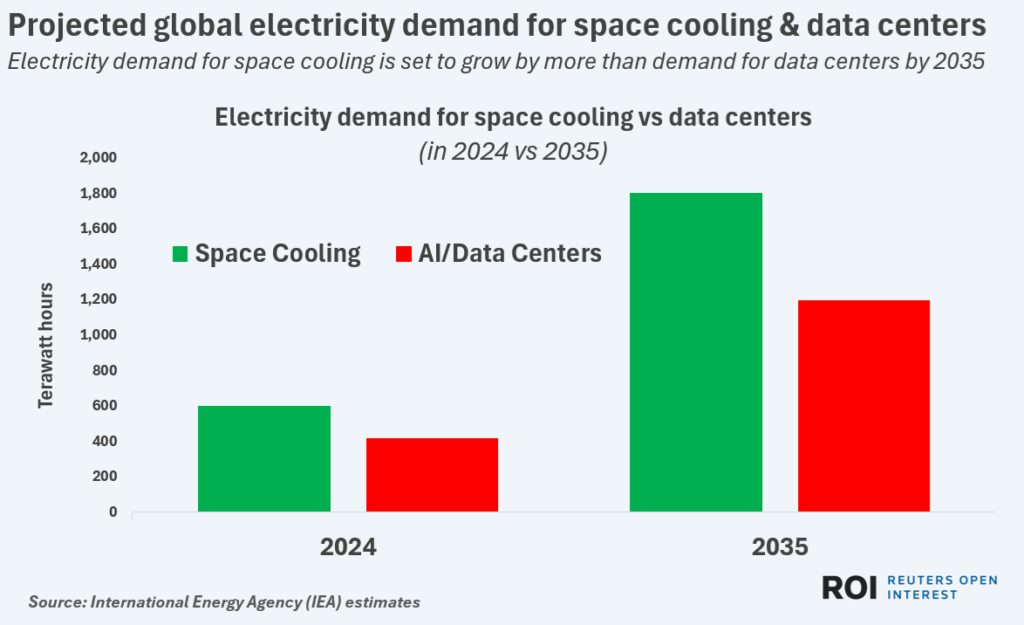
Source: Reuters, June 2025
For building managers, that’s both a risk and an opportunity.
On one hand, extreme heat drives higher costs and puts more strain on HVAC equipment. On the other hand, it opens the door to new ways of managing energy and generating value by reducing demand at critical moments – a practice called “demand response”.
Cooling demand is not only one of the fastest-growing loads on the grid, but it’s also one of the most difficult to manage for two reasons: it’s volatile and not very flexible.
Volatile: it reacts sharply to weather. On a mild day, cooling demand might be low, but as soon as temperatures rise past a certain point (often in the early afternoon), it can spike across an entire region within hours.
This kind of synchronized surge is difficult for utilities to predict with precision, and even harder to cover in real-time. Grid operators must keep expensive, carbon-intensive backup energy sources, called peaker plants, on standby to cover a few critical hours. These peaks are happening more frequently and in more places as climate patterns shift.
Inflexible: air conditioning is not exactly optional during heatwaves – it’s a load that building managers can’t adjust without consequences. During extreme heat, cooling is tied directly to occupant safety, and legal requirements mean cutting back isn’t an option.
In some multifamily buildings, cooling is also managed at the unit level, not centrally, making coordinated reductions a challenge.
This combination helps explain why cooling has become such a high priority for grid operators. It’s a key source of load that can have a large system-wide impact if made slightly more responsive.
That’s where demand response comes into play. Demand response is a tool that utilities implement to keep the grid stable during peak demand periods. When electricity use is expected to spike, usually during extreme heat, buildings enrolled in a demand response program are asked to reduce energy consumption. In return, they receive compensation based on how much energy they reduce during the demand response event.
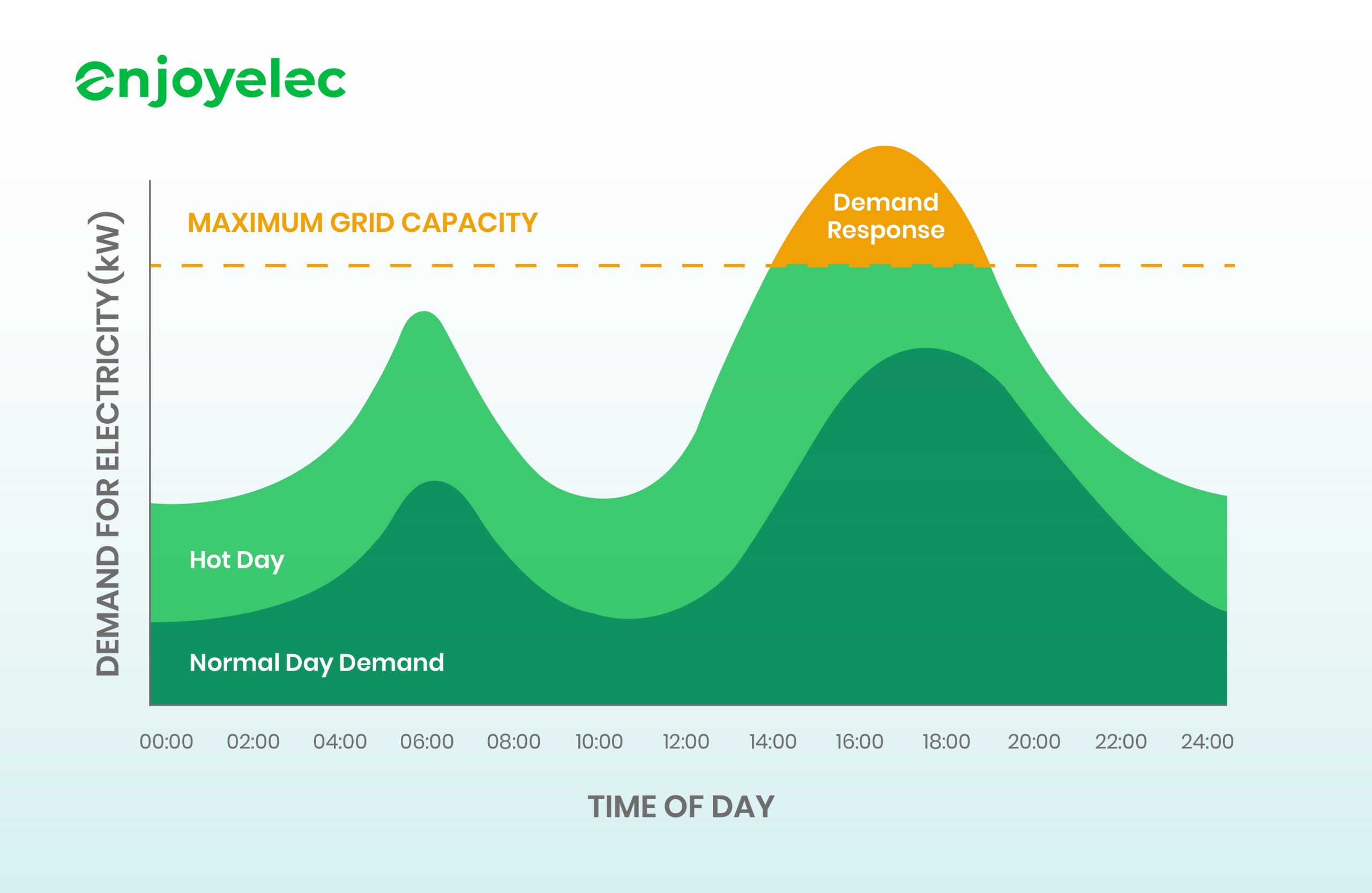
Image credit enjoylec
A single apartment building reducing its consumption at peak demand might not move the needle on its own. But when thousands of buildings shave a small amount of energy at the right moment, it reduces the need for emergency generation, lowers costs, and gives grid operators more flexibility to keep power flowing where it’s needed.
The advantages multifamily buildings have with demand response:
Multifamily buildings were once considered too complex for demand response. Decentralized HVAC systems, concerns about tenant comfort, and limited on-site staff made participation difficult.
That perception is starting to shift, with automation playing a key role.
Automation maximizes a building’s financial return while reducing the burden on site staff. Instead of manually adjusting equipment or watching the clock, the building responds in real time through pre-programmed logic tuned to its specific layout and performance patterns.
Parity helps multifamily buildings automatically participate in demand response events, without sacrificing comfort or relying on manual efforts from the building staff. Our technology integrates directly with HVAC systems to precisely curtail load, recover smoothly, and unlock a new source of recurring revenue.
For a clear example of how small, well-timed contributions from individual buildings can play a meaningful role when the system is operating near its limits, look no further than the heatwave that swept across the Northeastern US this past June (the planet’s third-warmest June on record).
On one of the hottest days of the year, electricity demand in New York City surged to 12,600 megawatts—just 10 megawatts below the forecasted peak of 12,610 MW. Within that window, Parity-automated multifamily buildings provided approximately 300 kilowatts of curtailment.
That single contribution equates to the real-time power needs of around 250 homes. It may be a small fraction of the total load, but it was delivered precisely when the grid needed it most, without tenant complaints or staff intervention.
Moments like this underscore how distributed, responsive demand from residential buildings is becoming an increasingly valuable part of grid stability. One building can’t prevent an emergency on its own, but many buildings acting together can certainly tip the balance.
Demand response is evolving from a niche option to a core grid strategy. As programs and platforms continue to mature, multifamily buildings are becoming an active, vital part of the equation.
To learn more about maximizing demand response revenue through automation, email contact@paritygo.com or call 1-833-372-7489.
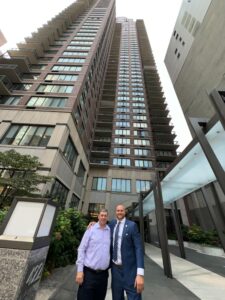
The Oxford is a 44-story condo nestled in the Upper East Side neighborhood of New York City.
The building is maximizing its payouts to reduce energy during demand response events by letting Parity automate and control its HVAC systems.
Demand response events generate financial rewards for buildings when they agree to lower energy use during specific hours, typically during the warmest days of summer, to protect the grid.
Buildings get paid per kW reduction during scheduled or sometimes unscheduled demand response events.
“The resident manager isn’t running around manually turning things on and off on the hottest day of the year, which takes forever,” Joe Cascio, Parity’s service delivery manager, told Habitat Magazine.
That’s because Parity automates demand response protocols to run during demand response events.
We can accomplish this because we remotely control the building’s HVAC systems. That gives us a deep understanding of the building’s real-time heating and cooling demand, enabling us to automate their system with a unique level of precision.
In the same Habitat article, Gerry Grady, the Resident Manager at The Oxford, said “Once a demand response event is called, the systems will automatically revert to the lowest settings or be switched off.”
This automation avoids any delay in lowering energy use and maximizes payouts.
At The Oxford, for example, we automate and control the ventilation units and exhaust fans. Our cutting-edge control optimization software allows fan speeds and temperature settings to be dialed back or turned off for demand response events.
We worked with Gerry to pre-program the level of curtailment he was comfortable with to reduce any impact occupants may face from the temporary reduction in energy usage.
Parity can automatically “switch” the building into demand response mode when the notification of an event is received from the demand response aggregator.
When the notification of an event is received from the demand response aggregator, our automation goes into effect.
Buildings enroll in demand response programs through demand response aggregators. In this case, The Oxford choose to work with our friends at Logical Buildings.
Logical Buildings estimated the reward for The Oxford will be in the region of $10,000. But that payout isn’t the only perk.
On a typical summer afternoon, The Oxford uses ~1,176 kWh of electricity.
Grady told Habitat Magazine that during three demand response events in July, common area energy usage dropped by around 44%, double their target.
By lowering energy use during demand response events, buildings avoid paying the more expensive electricity delivery rate during the specified timeframe.
The Oxford saved almost 2,000 kWh of energy in total, amounting to several hundred additional dollars in savings.
Are you ready to learn more about how automating demand response events can earn your building an additional revenue stream?
We’re hosting a webinar with Logical Buildings to share how working with both of us can help your building slash its energy use and earn revenue from utility programs.
You will hear from James Hannah (Managing Director at Parity), Joe Cascio (Service Delivery Manager at Parity), and David Klatt (COO at Logical Buildings) on the details of why automating demand response is the next thing you should implement in your building.
You can sign up for our upcoming webinar here.
You can also email contact@paritygo.com or call 833-372-7489 to tell us that you’re interested in working with Parity.
With the growing focus on the electric grid and the need to reduce CO2 emissions, demand response programs present an excellent opportunity for property and resident managers.
Demand response (DR) is a strategy employed by utility companies to manage electricity consumption during peak demand periods. These typically coincide with the warmest days of summer, when the electric grid is the most vulnerable, and its emissions are usually the highest.
DR involves reducing energy demand in real-time or on a pre-determined, typically 2-4 hour window. This is called a demand response event (DR event).
Buildings that participate in demand response programs will reduce their electricity demand, reduce strain on the grid, and receive financial incentives from utility companies.
Buildings get paid per kW reduction during scheduled or sometimes unscheduled demand response events. For example, there are usually between 4 to 8 demand response events a year in a typical season in New York’s ConEd demand response program. This is a great opportunity for buildings to earn additional revenue.
Parity can automate demand response curtailment to maximize revenue and reduce the impact of the temporary energy reduction for occupants during a DR event.
Parity automates demand response protocols to run during demand response events.
We can do this because we remotely control a building’s HVAC systems. We have a deep understanding of the building’s real-time heating and cooling demand, so we’re able to automate their system with a unique level of precision.
For example, we can automate ventilation equipment for a demand response event. It’s normally not feasible for maintenance staff to scramble up to the roof to manually do this for every DR event.
By working with the resident manager to pre-program the level of curtailment they are comfortable with, Parity can automatically “switch” the building into demand response mode when the notification of an event is received from the demand response aggregator.
This allows Parity to maximize revenue for the building while reducing any impact occupants might face from the temporary reduction in energy usage. Plus, this prevents possible mistakes or underperformance by eliminating manual actions from Resident Managers or superintendents.
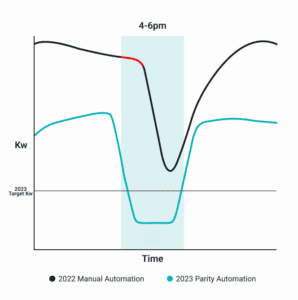
2023 Parity DR Example
The above graph shows Parity lowering the overall energy demand measured in kWs. Here are 3 points about the graph worth mentioning:
Starting on Time:
Resident managers and their staff may not be available immediately at the start of the DR event. This is compounded by DR events occurring on the hottest days of the year when they are already swamped.
In the graph, the 2022 line shows the building started curtailment almost a third of the way through the event. With our automation, we begin curtailment slightly before the event to maximize revenue. We can also set up automated pre-cooling.
Depth of Curtailment:
It’s difficult to know how far you can take curtailment without affecting residents’ comfort. Since Parity gains a deep understanding of HVAC system operations at each building, we can develop customized curtailment programming. This can include pre-cooling, a process where cooling is run at nearly full capacity for around 2 hours before the event, which is another benefit of our automation. If we pre-cool, we can avoid tenant issues. This is particularly important for longer events (4+ hours).
Return To Baseline:
In 2022, it took far longer for the building staff to return the systems to their previous setpoints, which could potentially impact resident comfort without generating any DR revenue for the building.
With our automation, the system returns to its baseline within minutes of the event ending. You can also see how, at the end of the event in 2023, our automation didn’t increase kWh as much.
For buildings with centralized HVAC, joining a demand response program is easier than ever.
Most participation begins with enrollment through a utility or third-party aggregator. Once enrolled, buildings receive notifications ahead of peak demand events, typically with a few hours’ notice.
The challenge isn’t signing up. Rather it’s responding in a way that’s fast, consistent, and minimally disruptive. Reducing load at the right time without affecting comfort or burdening staff requires automation.
That’s where platforms like Parity come in. By integrating with a building’s HVAC controls, Parity enables curtailment to happen automatically. The system pre-cools in advance, adjusts during the event, and returns to normal without creating a rebound. Everything is configured to match the building’s equipment and comfort preferences.
What was once a manual, unpredictable process is now programmable. In many cases, the biggest question isn’t whether a building can support the grid; it’s whether the building has the right technology in place to make a meaningful contribution.
Demand response will reduce your building’s energy consumption, earn additional revenue, and help stabilize the grid. With Parity, building staff can kick back and relax while we automate demand response protocols to maximize revenue and ensure occupant comfort.
We hosted a recent webinar with Logical Buildings, sharing how we help AvalonBay Communities automate their energy management, support Local Law compliance, and earn maximum demand response revenue.
Are you ready to learn more about how Parity automates demand response curtailment? Email contact@paritygo.com and tell us that you’re interested in automating demand response for your building.
Managers of multifamily buildings and hotels face a unique challenge in optimizing HVAC systems.
With the growing focus on the electric grid and the need to reduce carbon footprints, demand response programs present an excellent opportunity for property and resident managers.
Demand response is a strategy employed by energy providers to manage electricity consumption during peak demand periods.
This typically coincides with the warmest days of summer, when the electric grid is most vulnerable. It involves adjusting energy usage in real-time or on a pre-determined basis to reduce electric demand on-site.
For more context, we suggest watching this intro video:
By participating in demand response programs, buildings will reduce their electricity usage, reduce strain on the grid, and receive financial incentives for their efforts. Parity can automate DR protocols for events and reduce the impact of the temporary energy reduction for occupants.
Buildings get paid per kW reduction during scheduled or sometimes unscheduled demand response events. In a typical season, there could be between 4-8 DR events a year, leading to a great opportunity for buildings to earn additional revenue.
Parity can automate demand response protocols to run during demand response events. We have a deep understanding of a building’s HVAC systems, so we’re able to automate their system with a unique level of precision.
For example, we have been able to automate ventilation equipment for a demand response event. This isn’t feasible for maintenance staff to manually do this for Demand Response events.
Parity remotely controls a building’s HVAC systems. This allows Resident and Property Managers to not have to manually perform any protocols, preventing possible mistakes or underperforming.
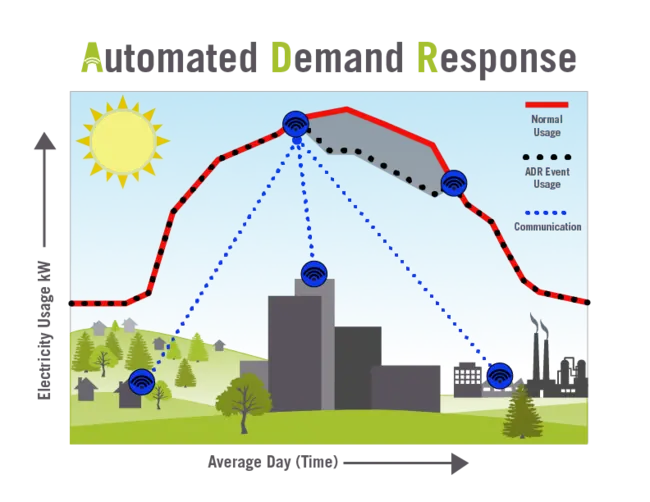
Source: https://energycentral.com
Demand response is a powerful tool that property and resident managers can leverage to reduce energy consumption, earn additional revenue, and stabilize the grid. Embracing HVAC optimization through DR is a win-win situation for property managers and their occupants as they contribute to a greener, more energy-efficient future.
Take the first step today and reach out to us if you’re interested in enrolling your building in a DR program!